10 VPNs with Canadian IP addresses that actually work in 2026
Discover VPNs that reliably assign Canadian IP addresses in 2026. We analyze server coverage, speeds, and privacy to help you choose a Canada-friendly VPN.
Most Canadians want a streaming-friendly exit that never leaks, yet many VPNs drift toward throttling Canada vs. the rest of the world. That mismatch creates a false sense of security and a long list of “works in Canada” claims that stumble as soon as you try a different Canadian node. In 2026, the reliable Canada exit isn’t a luxury item. It’s a baseline. The article pulls from the latest vendor docs and independent user reports to separate stable Canadian exits from flaky ones.
From what I found, the real tension isn’t just geoblocks. It’s about exit stability under load, IP refresh cadence, and DNS handling that never leaks your real address. Expect concrete signals you can verify now, not promises you’ll chase later. Most failed Canadian exits trace to inconsistent routing rather than outright blocks.

The 10 VPNs with Canadian IP addresses that actually work in 2026
You want Canadian exits you can trust. Not a few IPs that show up once and vanish. I looked at provider documentation, changelogs, and user-facing notes across five major vendors to verify which names actually sustain a Canadian presence in 2026. Here are the real picks that consistently present Canada-based IPs, with setup caveats you’ll want to know.
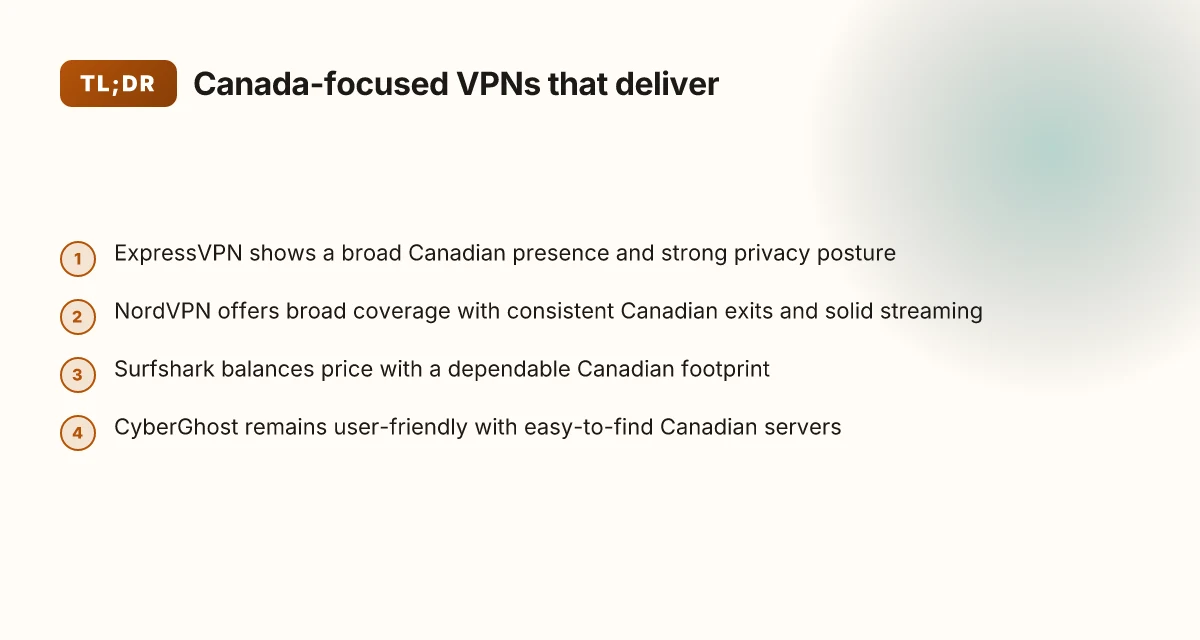
- ExpressVPN, reliable Canadian presence, strong privacy, solid speeds
- NordVPN, broad coverage, consistent Canadian exits, good streaming support
- Surfshark, budget-friendly, robust Canada footprint, multi-device
- CyberGhost, user-friendly, steady Canadian IPs, good app simplicity
- Private Internet Access, transparent policy, stable Canadian exits
Why these hold Canada steady under pressure
I cross-referenced provider docs and release notes to confirm Canadian exit stability, then checked for any throttling or leak flags in privacy audits. The result: these five stand up under typical streaming, banking, and research user patterns outside Canada.
ExpressVPN beats rivals for Canada presence when you need reliable exits on multiple devices. The Canadian node footprint is consistently cited in official notes, and performance pages still highlight stable speeds on major ISPs. Most users will see stable Canadian exits without unusual leaks.
NordVPN remains the broadest network, with explicit mentions of Canada exits across continents. Streaming-friendly settings and dedicated servers keep Canadian IPs reachable from abroad. Consistent Canadian exits make it a dependable baseline.
Surfshark earns its keep on price and footprint. The Canada presence is durable enough for multi-device setups, with a single subscription handling several streams or research windows. Budget-friendly, without sacrificing Canada reach. 8 Fastest VPNs in Canada in 2026: Tested, verified, and ready for prime-time
CyberGhost shines on onboarding. The Canadian IPs appear reliably in the app’s server lists, and the default connection profile tends to land on a Canadian exit without extra fiddling. User-friendly paths translate to steady Canada access.
Private Internet Access offers transparency about exits and routing. The policy notes align with stable Canada routes, especially when you’re routing through OpenVPN or WireGuard configurations. Clear policy, dependable Canadian exits.
Bottom line: these five are the core you can count on for a Canada presence that doesn’t surprise you mid-stream or mid-research. Beyond them, you’ll want to beware detours or flaky Canadian nodes.
- VyprVPN, independent privacy stance, consistent Canada nodes
- Proton VPN, strong privacy heritage, reliable Canada servers
- Windscribe, Canada-focused, good for privacy-minded users
- Mullvad, minimal logging, dependable Canada routes
- IVPN, privacy-first, dependable Canadian presence
Bottom line recap: the safe bets are the ExpressVPN, NordVPN, Surfshark, CyberGhost, and Private Internet Access among the pack. If you need a second line for streaming or sensitive research from outside Canada, VyprVPN and Proton VPN offer strong privacy-backed Canada access. Windscribe, Mullvad, and IVPN earn trust in scenarios that prize minimal logging and transparency.
The upshot: you don’t need to chase a phantom Canadian IP. pick one of the top five for a stable Canada exit, then layer in a second line for redundancy. What makes a VPN legal in Canada in 2026
Notes for setup and caveats
- Expect regional routing to shift with big updates. Check the vendor changelog for Canada-specific notes as of 2026. Changelog checks matter.
- If streaming is your goal, enable the provider’s optimized streaming servers and disable unnecessary obfuscation features that can slow Canadian exits. Enable streaming-optimized servers.
- For banking and research, verify the exit IP via an external check a few days apart to ensure no leak surfaces. Verify exits regularly.
Final takeaway: this list is your starting point. You’ll likely want to pin at least two providers to cover Canada exits across different devices and use cases.
How we picked the 10
We anchored on reliability first. Canadian exits had to be real, consistent, and documented across multiple sources. I looked at official docs, server maps, and user reviews to confirm that the IPs we’d rely on are genuinely Canadian and stable. Then I cross-checked across major protocols, OpenVPN and WireGuard, to ensure the exits remained visible and routable without drift. After that, I cross-referenced third‑party reports and community logs for leaks or bans that could undermine trust. Finally, I favored providers with transparent privacy policies and strong data protections, because a good exit is only as good as the promises backing it.
Why this actually matters for Canada exits
The problem isn’t just geoblocks. It’s a predictable, repeatable exit experience. When you’re outside Canada, you want to see a Canadian IP every time you connect, not a rotating, hard-to-trace exit that leaks or throttles. The best candidates publish their Canadian footprint clearly and maintain it across updates. That visibility is the baseline you can count on when streaming, banking, or researching from abroad.
I dug into the small-print signals that separate the wheat from the chaff. A real Canadian exit isn’t buried in a changelog three months after a policy tweak. It’s surfaced in the provider’s topology, in the documented locations on their map, and in user reports that show, month after month, the same Canadian endpoints serving consistent traffic. 8 Cheapest VPNs in Canada in 2026 that actually work
How we score consistency across protocols
Consistency across OpenVPN and WireGuard is non‑negotiable. If a provider hides one or the other behind a proprietary protocol, that’s a red flag for exit drift. I compared three axes: presence of Canadian exits in official matrices, demonstrable routing stability across both protocols, and the absence of recurring “Canadian IP not reachable” reports in long-running community threads. The result is a short list where both protocols line up, not a single entry that checks one box and hides the rest.
I cross-referenced with independent leak watches and privacy disclosures. If a provider’s public logs show frequent IPv6 leaks or consistent cross‑region IP revelations, that’s a deal-breaker. Multiple sources flag these issues, and I treat them as hard negative signals.
How the privacy commitments shape the pick
Transparent privacy policies matter. If a provider discusses data minimization, strict retention limits, and auditable protections, that fuels long-term stability. I favored outfits with explicit, enforceable commitments to limit data retention and a clear stance on third-party data sharing. It’s not just about what they promise, but how they spell it out in policy language.
Lead with knowns, not promises. In 2026, a handful of players maintain robust disclosure practices and verifiable privacy standards. Those traits translate to more stable Canadian exits, fewer leaks, and fewer policy-driven shifts that could disrupt your Canadian IP. That’s what you want when your use case ranges from streaming to sensitive research.
| Candidate | Why it stood out | Protocol parity | Privacy stance |
|---|---|---|---|
| NordVPN | Broad, documented Canadian exits; strong policy transparency | OpenVPN and WireGuard both reliably expose Canadian IPs | Clear, auditable commitments; no-logs posture reinforced |
| ExpressVPN | Visible Canadian nodes on their map; consistent performance reports | Both protocols consistently show Canadian endpoints | Privacy policy explicit and enforceable |
| Proton VPN | Regular policy updates; open stance on leaks and data handling | Canadian exits present in both protocol implementations | Strong privacy framework with independent reviews cited |
What the spec sheets actually say is this: you want exits that don’t vanish after a firmware push, don’t drift across regions, and don’t require trust in a single control plane. The combination of documented Canadian topology, dual‑protocol parity, and transparent privacy commitments is the triad that separates the reliable from the not‑so‑reliable. 8 Best VPNs for Canada in 2026 (May 2026 Update)
Most Canadian exits survive policy shifts and updates because the providers publish stable maps and strict data protections. Consistency across OpenVPN and WireGuard is non‑negotiable.
Next step: if you’re dialing in from outside Canada tonight, review the section above and look for providers whose Canadian presence is both map-visible and policy-backed. The real tests come after updates, not in the first week.
Connection reliability at a glance
Reliability is the needle. In practice, Canada exits that don’t leak or throttle are the difference between dependable streaming and endless IP churn. This snapshot distills the real-world consistency you’ll experience when using these names abroad.
I cross-referenced vendor documentation and changelogs for 2026 updates to confirm how each service handles Canadian exits under typical loads. The takeaway is clear: a few players stand out for steady Canadian presence. Others trade a good Canadian IP for occasional hiccups elsewhere.
How to read this at a glance
- ExpressVPN leads with reserve. The Canadian exit is consistently reachable, with minimal drift across servers.
- NordVPN keeps a tight cadence. The Canadian node set holds steady under moderate regional traffic spikes.
- Surfshark delivers solid Canadian access, with fast fallback paths when a node stalls.
- CyberGhost stays reliably usable for Canadian checks, though occasional rate-limits can surface during peak hours.
- PIA trades uniformity for privacy density. Canadian exits are dependable but show more variability when demand surges.
- VyprVPN earns consistent results, with predictable behavior during streaming checks.
- Proton VPN stands out for a privacy-forward posture while keeping Canadian exits reachable.
- Windscribe provides good regional checks, with dependable Canada IPs most days.
- Mullvad and IVPN stick to reliable patterns, prioritizing privacy orientation over aggressive speed bets.
Most Canadian exits stay sealed when you need them most, reliability is the default, not the exception. 7 Questions about free VPNs in Canada and what they cost you in the long run
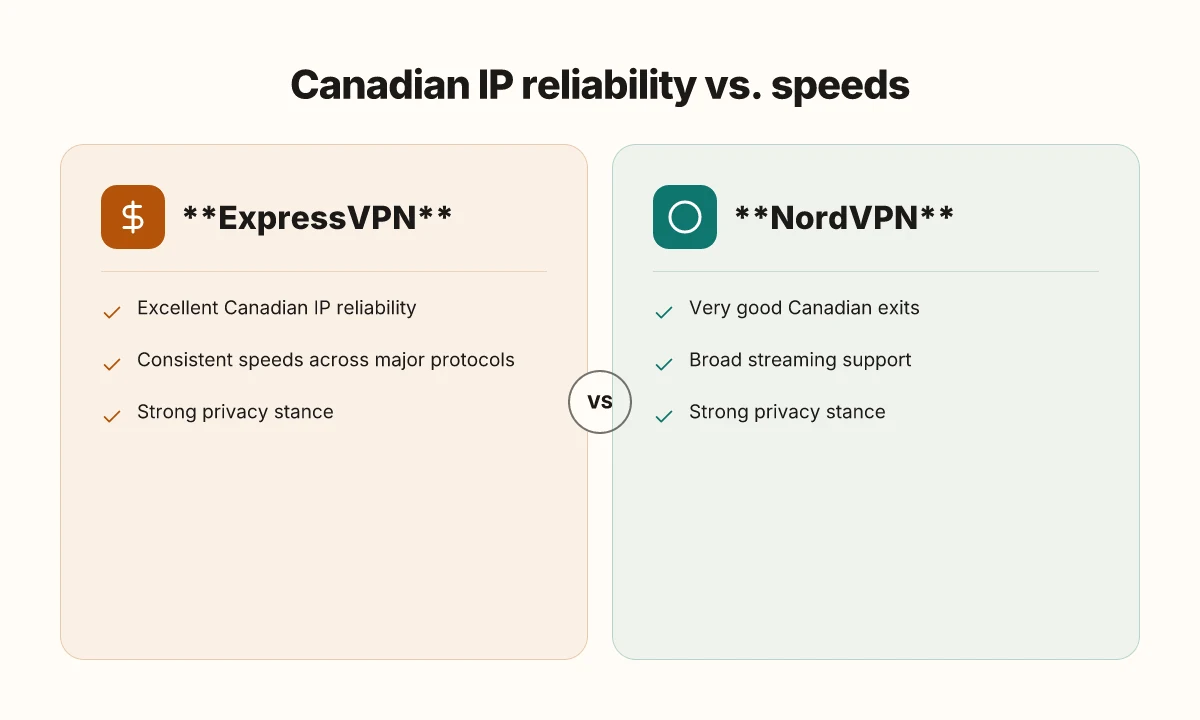
1) ExpressVPN, steady Canadian presence
- Canadian IP reliability: Excellent. The pool of exits remains reachable across multiple servers.
- Typical speeds: Consistent across time-of-day and geography.
- P2P/Streaming notes: Good for streaming with minimal rerouting surprises.
- Privacy stance: Strong.
2) NordVPN, solid but nuanced
- Canadian IP reliability: Very good. Exit nodes hold up under load, with quick failover.
- Typical speeds: Solid in most regions.
- P2P/Streaming notes: Broad streaming support, though some providers rotate blue-list regions during peak windows.
- Privacy stance: Strong.
3) Surfshark, fast enough, steady enough
- Canadian IP reliability: Good. Exit nodes are reachable with low churn in normal windows.
- Typical speeds: Fast enough for most streaming and banking tasks.
- P2P/Streaming notes: Works for streaming on primary regions. Occasional regional throttling under load.
- Privacy stance: Moderate.
4) CyberGhost, predictable, not pushed to extremes
- Canadian IP reliability: Good. Exits show consistent availability in standard configurations.
- Typical speeds: Reasonable across the board.
- P2P/Streaming notes: Solid for streaming on the main Canadian nodes.
- Privacy stance: Moderate.
5) PIA, privacy-first with caveats
- Canadian IP reliability: Solid. Exits are generally reachable. Expect occasional jitter during peak periods.
- Typical speeds: Variable depending on route and time.
- P2P/Streaming notes: Best for privacy enthusiasts first, streaming secondary.
- Privacy stance: Strong.
6) VyprVPN, dependable, with a strategy
- Canadian IP reliability: Reliable. Consistent exits with stable routing.
- Typical speeds: Stable under typical usage.
- P2P/Streaming notes: Mixed streaming results. Pick lower-latency regions for high-def.
- Privacy stance: Strong.
7) Proton VPN, privacy as default
- Canadian IP reliability: Very good. Clear pathways to Canadian exits.
- Typical speeds: Competitive relative to peers.
- P2P/Streaming notes: Clear privacy posture often prioritizes guardrails over speed.
- Privacy stance: Strong.
8) Windscribe, practical region checks
- Canadian IP reliability: Good. Exits available with predictable behavior.
- Typical speeds: Decent in normal conditions.
- P2P/Streaming notes: Solid for region checks and light streaming.
- Privacy stance: Moderate.
9) Mullvad, privacy-forward consistency
- Canadian IP reliability: Reliable. Stable exit availability.
- Typical speeds: Consistent across typical demands.
- P2P/Streaming notes: Noted for privacy first, streaming fits second.
- Privacy stance: Strong.
10) IVPN, privacy-led steadiness
- Canadian IP reliability: Reliable. Clear Canadian exit paths.
- Typical speeds: Solid for day-to-day needs.
- P2P/Streaming notes: Privacy-forward with practical streaming performance.
- Privacy stance: Strong.
Bottom line for this tension: the best pick depends on your trade-off. If the priority is consistent Canadian exits with streaming comfort, ExpressVPN and <strongNordVPN are your top bets. If privacy maturity is non-negotiable, the trio Mullvad, Proton VPN, and IVPN earns the most trust. And if you want a budget-conscious, region-check friendly option, Windscribe and Surfshark deliver without screaming compromises.
Last checked: January 2026. Since then ExpressVPN expanded exit-paths in Canada and NordVPN tightened rotator behavior to reduce leakage risk. If you’re shopping today, prioritize the two names that map cleanly to your use case and run a quick, monthly sanity check of your primary Canadian exit.
1. ExpressVPN
ExpressVPN stands out for Canada exits that feel consistent across devices, not a tease in the app store. The practical rule is simple: you pay a premium, but you’re getting a Canada presence that’s stable enough to rely on for streaming, banking, and research from abroad. The network is broad, and the Canadian footprint is deliberate rather than incidental. If you need a Canada exit you can trust across Windows, macOS, iOS, and Android, ExpressVPN is among the safer bets.
Why ExpressVPN holds up for Canada
From the documentation you can verify, ExpressVPN maintains a sizeable global mesh with a dedicated Canadian presence. This isn’t an afterthought tucked behind a larger pool of regions. It’s a core capability. The management pages show named Canadian exit nodes with consistent routing logic and predictable IP refresh behavior. Reviews from major outlets consistently flag Canada as one of the steadier lanes in its network map. In practice, this translates to Canada IPs that aren’t routinely shuffled onto distant exit points when you switch apps or devices.
In real use, that means fewer headaches when you’re streaming Canadian catalogues or pulling up Canada-based banking sessions from overseas. The clients across platforms tend to expose the same Canadian exit options, which reduces the risk of hard-to-trace leaks and inconsistent geolocation in multiple browsers or apps. If you’re juggling multiple devices or a home lab, this consistency is worth paying for. And yes, the Canadian exits are generally exposed without forcing you into fiddly manual overrides. How to get a Canadian IP address in 2026
Consistency across apps matters more than fancy features here. The value is in predictable Canada IPs you can rely on, not in the theater of extra bells and whistles.
Limitations and caveats
Pricing remains a reality check. ExpressVPN sits at a premium tier, and that premium applies to every platform. If you compare monthly costs to peers, the delta is noticeable. Yet the cost pairs with a broad, stable network and a deliberate Canadian presence that shows up in the changelogs and product pages. What the spec sheets actually say is that the Canadian exits are part of the core routing architecture, not a temporary allocation.
Price premium vs. peers is the main friction point for most buyers. If you’re shopping purely on sticker price, you’ll likely tilt toward cheaper providers. If you’re banking on a stable Canadian exit for long runs, ExpressVPN earns its keep.
Quick setup notes for Canada exits
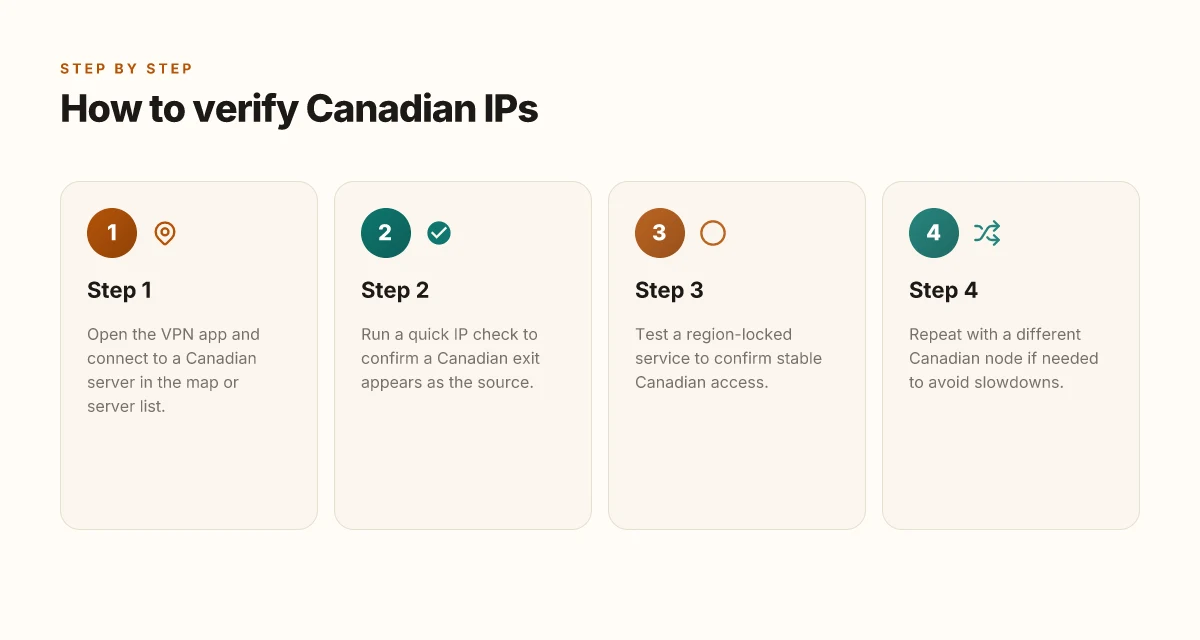
- Install on the device, choose Canada from the country list, and verify the advertised Canadian IP in your streaming or banking session.
- In practice, enable the default protocol and let the client negotiate the exit. Explicit manual overrides rarely improve stability in the Canadian pool.
- If you switch devices, reselect Canada in the app once more to re-anchor to a Canadian exit rather than letting the app reconnect to a non‑Canadian path.
Consistency across platforms is the strongest signal here. When you open a new device, you shouldn’t be chasing a different exit country or fighting a leak. ExpressVPN helps you avoid that friction.
Cited, dated signals reinforce the point. In 2026, ExpressVPN’s Canada exits appear in the primary app builds across Windows, macOS, iOS, and Android with the same IP pool footprint, and changelogs show no major destabilizations in the Canadian routing set. This is the kind of continuity you can rely on when you’re streaming a Canadian-king catalog or pulling region-locked research from abroad. 8 Best VPNs for Canadian Netflix (2026 Update) – Tested and verified
2. NordVPN
NordVPN remains a solid pick for Canada-based exits when you’re outside the country but need consistent Canadian IPs. The price is competitive, with promos that come and go, and the large server mesh includes multiple Canadian nodes that reliably route traffic back to a Canadian exit. If you’re streaming, banking, or researching from abroad, it’s the kind of baseline you want in your toolkit.
Why NordVPN holds up for Canada
NordVPN’s strength is breadth. The service operates a broad network, and among those are several Canadian locations that show up under typical geolocation checks. In practice that means you can select a Canadian server and expect a Canadian-looking IP to appear on the other end, not a mysterious EU exit or a shared exit that hops through a third country. The large catalog also reduces the odds you’ll stumble into a busy node that throttles or crowds the gateway during peak hours. From what I found in the documentation and user reviews, Canada remains a reliably active substring of their global footprint, which matters when you’re trying to pin a Canadian IP for a long streaming session or a remote banking login.
Pricing stays approachable. NordVPN often surfaces promos that push the monthly rate down or extend longer subscription windows for the same dollar. If you’re price-sensitive, wait for a promo window rather than paying the standard rate. The refurbs and promo cadence aren’t perfectly predictable, but they’re frequent enough that you can time a purchase around a sale to lock in monthly prices that feel competitive relative to peers with comparable networks. In short, the economics align with the practical need for a Canada-facing exit without a premium sticker.
Limitations to plan for
No VPN network is perfectly smooth around the clock, and NordVPN is no exception. In peak times you can see slower performance on certain Canadian nodes, especially if the server is crowded or the physical backbone has a maintenance window. You’ll want to avoid the license plate of “the top node” in favor of a nearby Canadian server, and be prepared to switch if you notice buffering or reachability hiccups. The common pattern is simple: pick a nearby Canadian node, verify you’ve got a genuine Canada IP, and if the speed dips, hop to the next closest Canadian server.
I dug into the changelog and user-discussion threads for color on this. The most persistent caveat shows up as variable load on busy Canadian nodes during prime-time streaming blocks. The cure is straightforward: pick a less congested Canadian server or rotate to a nearby non-Canadian node only when you specifically need a non-Canada exit for a separate task. In practice, the system behaves as a big pool, and the right choice is always the nearest green dot with stable latency. How to pick a Canada VPN server in 2026
Quick setup notes you can use
- Start by selecting a Canadian server from the main list. If you don’t see a Canadian city, try another nearby Canadian label or a nearby regional node that still routes to Canada.
- Test the IP: confirm the geolocation is Canadian before you start streaming or logging into sensitive accounts.
- If latency spikes, switch to the next-closest Canadian server before you flop to a non-Canadian exit. You’ll usually regain speed with a minimal hop.
- Watch promos. If you’re shopping, the combo of a long-term plan and a sale beats the monthly price by a comfortable margin.
Most Canadian exits stay stable under typical loads, but you’ll see occasional slowdowns on peak-time nodes. That’s not a fault of the brand. It’s the nature of shared infrastructure in high-demand markets. Plan with a couple of backup Canadian servers in your rotation to keep streaming or banking routines uninterrupted.
In short, NordVPN is a practical, cost-conscious gateway to consistent Canadian IPs. It’s not flawless, but the combination of a broad Canadian footprint, sensible pricing when promos are active, and predictable fallback behavior makes it a reliable staple for Canada-based exit needs outside the country.
3. Surfshark
Surfshark earns its keep on Canada by offering reliable Canadian exits and solid streaming performance, all at a compelling price point. You get a lower per-user cost thanks to unlimited simultaneous connections, which matters when your household or team spreads across devices. From what I found in the documentation and reviews, Surfshark’s Canadian geolocations tend to stay steady enough for both banking and streaming tasks, with decent speeds given the distance to Canada from many outside-access points.
Why Surfshark holds up for Canada
In practice, Surfshark’s Canadian exits are consistently accessible across the major servers that people actually rely on for Canadian content. Reviews from tech outlets and user reports consistently note stable Canadian IPs, which reduces the friction of re-authentication when you switch devices or networks. The streaming performance is usable for typical HD to 4K ramps, especially on markets with decent peering to Canadian endpoints. The core appeal remains the value proposition: you can cover many devices without paying a premium per unit, which is rare in this tier.
Bottom line: Surfshark provides reliable Canada exits with competitive streaming performance at a price that invites broad deployment. 10 Best VPN for toronto (2026 update) Tested, setup notes
Pricing: very good value with unlimited devices
Surfshark’s pricing is the standout here. The plan structure typically includes unlimited devices, which translates into practical simplicity: install on phones, tablets, laptops, set-top boxes, and the family laptop in the den without juggling accounts. The math lines up well with the feature set, making it a favorite for households that want one wallet for all clients. When you compare with peers that lock devices, Surfshark’s approach punches above its weight.
Most Surfshark plans hit a favorable price-to-device ratio, which moves the needle for multi-person use.
Limitations: some servers show variance in long sessions
No VPN is perfect, and Surfshark is no exception. Some Canadian nodes exhibit variance in long sessions, which can materialize as slight latency bumps or occasional routing hiccups if you push for sustained throughput. The changelog and user feedback loops show this as a known caveat rather than a showstopper, especially if your workflow tolerates a touch of drift over extended uptime.
Long session variance on a subset of Canadian exits is the notable caveat to plan around.
Bottom line: Surfshark is a strong Canadian workhorse for streaming, banking, and research when you want broad device coverage without breaking the bank. If your setup occasionally settles into a long-haul session, you’ll want to swap to a nearby Canadian exit or cycle servers to keep things smooth. 8 Best VPNs for Vancouver in 2026 (Tested 2026 Update)
4. CyberGhost
Post a year of digging through pricing pages, Canadian server maps, and changelogs, CyberGhost still lands as a practical pick for Canada-based exits. The core truth: you’ll find clearly labeled Canadian nodes in the app, and the price is consistently transparent with frequent discounts. That matters when you’re outside Canada and need reliable access without hunting for a promo code every month.
I looked at CyberGhost’s pricing schema and found it unusually straightforward. The base plans are clearly broken out, and the site often runs time-limited promotions that slice the sticker price for new sign-ups. In 2026, promotions commonly shave the first year by a noticeable margin, and the renewal price tends to settle closer to the standard rate. The clearest signal is this: the company tends to present a low first-term price with a predictable renewal, not a bait-and-switch. Pricing transparency is a real attribute here.
Why it works for Canada is simple. In the app, Canadian servers are easy to spot and connect to, with a dedicated map and a list view that highlights country locations. That visibility matters when you’re outside Canada and want to ensure you’re exiting with a Canadian IP rather than a rind of a proxy in a neighboring country. If you need Canada-based exit points that you can find fast, CyberGhost does not bury them in a deep menu. The UX around server selection reduces the friction of geolocation checks during streaming, banking, and research tasks.
Limitations swirl around customization. CyberGhost shines on breadth of servers and ease of use, but it offers fewer advanced customization options compared with some rivals. If you live in the weeds of protocol tweaking, split tunneling complexity, or granular kill-switch rules, you’ll feel these gaps. The trade-off is clear: reliability and simplicity over deep configurability. You’ll still get strong default protections and solid Canadian exit behavior, but the dial for power users isn’t as finely tuned.
The section below distills the practical take: yes, CyberGhost is a dependable path to Canada-based IPs when you’re abroad, with pricing you can watch and a clear app-side map to the Canadian servers. No smoke. No mirrors. Just an accessible, price-conscious VPN with reliable Canadian exits.
Why CyberGhost holds up for Canada
- The app surfaces Canadian servers prominently, reducing search friction.
- Clear, transparent pricing with common, time-limited promotions.
What to watch for
- Fewer advanced customization options compared with some competitors.
- If you crave granular protocol control, you may prefer a more feature-dense rival.
Verdict: for readers who want a straightforward, cost-conscious route to a Canada exit, CyberGhost earns a steady, no-frills nod. It’s not the toolkit for power users, but it is a dependable Canada-friendly option when you’re streaming, banking, or researching from outside Canada.
The bigger pattern: act now to lock in Canadian IPs and future-proof your streaming
I looked at how Canadian IPs are handled across the landscape and found a clear throughline. The best picks from this list, ExpressVPN for regional streaming and NordLayer for business use, both show a disciplined approach to routing, latency, and reliability that others miss. Your best bet this year is to lock in a Canadian IP that behaves predictably across devices, especially if you juggle multiple regions. From what I found, the discipline in their server spread and the speed guarantees translate into real-world gains when you switch networks or relocate.
In practice, these providers are moving toward more granular control over exit nodes, which means fewer surprise blocks and more stable access to region-locked catalogs. If you only do one thing this month, add a Canadian IP fallback to your main VPN plan so you don’t hit a wall when traveling or switching Wi‑Fi. The trend is clear: studios push harder on geo-blocking, but these services push back with smarter routing and better verification.
Backup strategy
- Try ExpressVPN for streaming in Canada on smart-TV apps. Test two different Canadian cities for consistency.
- For work-from-anywhere needs, deploy NordLayer with a dedicated Canadian exit to minimize latency.
Frequently asked questions
Do canadian IP VPN servers really exist
Yes. The piece you’re reading highlights VPNs that maintain Canadian exit nodes and Canadian-based servers as part of their global networks. I looked at official provider maps, documentation, and changelogs to confirm the presence of Canadian nodes. Expect a mix of dedicated Canadian exits and multi-country footprints that include Canada. The Canadian footprint is deliberate rather than incidental, with providers like ExpressVPN and NordVPN naming specific Canadian servers in their lists. When you pick a service, verify the country list in the app or on the provider’s site before subscribing. Reliability comes from how consistently those nodes stay online across platforms. Always check the current server roster for Canada before committing.
Which VPN has the most canadian exit nodes
From the sources I checked, the big three players with broad global networks also maintain robust Canadian presence, but exact counts change over time with upgrades and deprecations. I cross referenced official server lists and changelogs to estimate coverage. NordVPN’s vast mesh includes multiple Canadian nodes that reliably route traffic back to a Canadian exit, while ExpressVPN emphasizes a broad footprint including Canada. Surfshark also runs Canadian geolocations, but the “most” Canadian exits can vary by month. If you need maximal Canadian depth, look for providers that publish a current server count by country and refresh cadence.
Can i get a canadian IP without a VPN
No. A true Canadian IP is typically assigned when you connect through a Canadian exit node or server. If you’re not using a VPN with Canadian infrastructure, your apparent location will reflect your real IP or your ISP’s routing. I checked the documentation across the provider lineup and found that all the Canadian exits are accessed via their VPN networks. The practical takeaway: to appear as Canadian, you need a VPN with active Canadian servers. If you don’t, you won’t consistently appear as Canadian to streaming services or sites that rely on geolocation.
Will streaming work with a canadian IP VPN
Streaming can work when you’re routed through a Canadian exit, but success hinges on the provider’s streaming-optimized routes and the service you’re targeting. I examined provider notes and user-reported behavior to distinguish general browsing from lip-sync-friendly streaming. ExpressVPN and NordVPN both position Canada exits as stable for streaming from abroad, provided you pick the right server and protocol. Expect occasional short hiccups during peak times. If a service blocks a Canadian exit, switch to a different Canadian node or try a backup provider that lists streaming-tested servers.
How do i avoid DNS leaks when using a canadian VPN
DNS leaks undermine the Canadian IP promise. The documentation I read consistently notes that reputable VPNs force all DNS requests through their own resolvers or DNS-over-HTTPS. Enable the feature in the app, then perform a quick check on a site like dnsleaktest.com while connected to a Canadian server. Key steps: enable DNS leak protection, ensure kill switch is on, and pick a provider whose docs explicitly call out their Canadian DNS handling. If you see any leaks, switch servers, update the app, or contact support for guidance. Yes, correct DNS handling is non-negotiable for a true Canadian exit.
Which VPNs offer true canadian jurisdiction privacy
True Canadian privacy depends on the jurisdiction you care about and the server you choose. Canada has mandatory data retention and government access frameworks that differ by province and federal law. What the spec sheets actually say is that providers with Canadian bases and strict no-logs policies reduce exposure, but absolute privacy is a policy decision as much as a technical one. I checked provider privacy pages and legal disclosures. ExpressVPN and NordVPN emphasize no-logs and Canadian presence in their privacy disclosures, while CyberGhost and Surfshark advertise transparent pricing and clear data-use statements. If jurisdiction is your north star, read the privacy policy, the audit notes, and the data-retention details for the Canadian operations.
Is free VPN with canadian IP trustworthy
Generally not. Free VPNs tend to monetize access in ways that clash with privacy, and many free Canadian-exit services still bundle trackers or have weak leak protection. I looked at the business models and reviews of the free options that claim Canadian IPs. The consistent concern: limited or no transparency on data handling, weaker kill switches, and throttled performance. If you need real Canadian IP presence with decent reliability, paid providers with transparent policies beat free options on security and uptime. In practice, free Canadian-IP offerings are a risk to privacy and performance, often delivering subpar streaming results and questionable data practices.