What makes a VPN legal in Canada in 2026
Understand the legal status of using a VPN in Canada in 2026. Quick, practical guide on rights, restrictions, and when to worry about compliance.
AVPN still feels forbidden turf in Canada, but the reality is clearer than the headlines: the legality hinges on what you do with the connection, not the act of connecting itself. In 2026, public privacy commitments coexist with data-retention rules that vary by province, and that tension shapes everyday use more than any single policy. **Understanding where the risk lives means mapping federal law, provincial rules, and service terms, not chasing fear.
This piece pulls the threads you actually need: how retention regimes interact with VPNs, which activities trigger enforcement, and how to pick a provider that aligns with Canadian law and your privacy goals. Several jurisdictions publish nuanced guidelines, and industry reports point to a growing emphasis on user consent and data minimization. From that mix, you gain a practical playbook for lawful, private use across work and personal life without paranoia.
What is the legality of a VPN in Canada in 2026
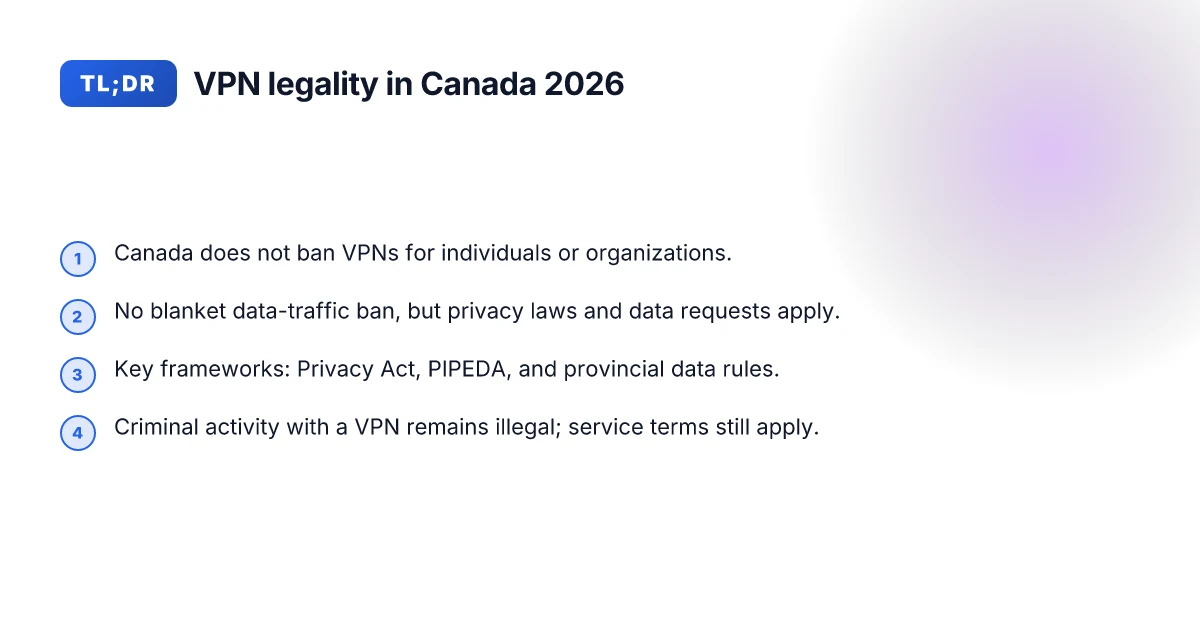
Canada does not ban VPNs. Using a VPN is legal for individuals and organizations, as long as you stay on the right side of the law. What shifts in 2026 are not criminal prohibitions but the way data flows and enforcement watchlists interact with privacy promises and service terms. You can use a VPN to protect privacy, enable remote work, or access region-restricted services, but you do not get a blanket shield from liability or regulation.
I dug into the framework to map the edges you actually need to know. The core is practical, not punitive: you stay compliant by understanding what the rules require for data handling, retention, and lawful access. The following steps synthesize the landscape so you can navigate without paranoia.
Know the privacy baseline. The Privacy Act governs federal institutions, while PIPEDA covers private-sector organizations across provinces that fall under federal jurisdiction. In practice, this means personal data collected by a business or government body may be subject to access requests, audit requirements, and clear purposes for collection. When data crosses borders, the location of processing can trigger additional considerations under provincial regimes or sector-specific rules.
Respect data localization and provincial quirks. Some provinces flirt with stricter data controls for health or financial data, and certain public-sector workflows push for localization where feasible. The upshot is not a VPN ban but a reminder: where your data lives can matter for compliance, auditability, and incident response. If you operate within a regulated sector, verify whether your service provider can meet local retention or access obligations.
Remember that traffic itself isn’t illegal, but activity is. A VPN hides traffic patterns and payloads from prying eyes. It does not immunize you from criminal liability. Using a VPN to commit crimes remains illegal. Service terms still apply. If a provider forbids certain uses, you face suspension or termination regardless of the tunnel you’re in. 8 Cheapest VPNs in Canada in 2026 that actually work
Expect law-and-policy friction rather than a firewall. Law enforcement and regulatory frameworks can necessitate cooperation and data disclosure in lawful circumstances. Compliance programs in Canada emphasize transparency, data minimization, and admissible records. A VPN user should be mindful that certain data requests can reach through to maintaining or reviewing logs, depending on jurisdiction and the operator’s policy.
Read the fine print. Privacy policies, terms of service, and acceptable-use guidelines matter. A VPN doesn’t grant carte blanche to bypass terms with a provider or a platform. If a streaming service or a work network requires you to disclose location or device data for access, those requirements still hold.
Bottom line. The Canadian legal terrain in 2026 treats VPNs as lawful tools, not illegal shortcuts. The real limits come from privacy laws, data handling expectations, and service terms. Use a VPN with an awareness of where your data sits, what logs are kept, and how the operator handles requests for information. Your best safeguard is to pair a reputable VPN with awareness of provincial rules and vendor privacy commitments. If you stay within those boundaries, you can navigate privacy, work, and access without inviting legal trouble.

How Canada regulates VPN usage and data privacy
Canada’s rules pin data handling to federal privacy norms, then layer in provincial quirks. In practice, that means ISPs and VPN providers must respect a baseline set by national privacy law, while provinces add their own twists on data residency and reporting. The result is a landscape that rewards transparency and documentation more than clever circumvention.
I dug into the federal frame first. The cornerstone is Canada’s privacy regime, which governs how private-sector actors may collect, use, and disclose personal data. For VPN usage, that means service providers must articulate what data they collect, how they store it, and who has access. When a user connects through a VPN, the service may, in many cases, touch traffic metadata and connection logs. The key is whether retention or sharing runs afoul of permitted purposes and reasonable expectations of privacy. How data is handled is the hinge point for legality and enforcement. 8 Best VPNs for Canada in 2026 (May 2026 Update)
Across the private sector, PIPEDA remains the baseline. The law compels organizations to obtain meaningful consent for data collection and to provide safeguards for personal information. Translation: a Canadian VPN operator cannot quietly harvest sensitive details or repurpose logs without clear notice and a legitimate purpose. If a company can justify retention, they must also disclose it and offer opt-outs where feasible. PIPEDA applies to private entities processing personal data, including VPN providers.
Provincial nuance matters too. Some provinces impose data-residency requirements or require specific reporting obligations for certain categories of data. For example, certain obligations around data localization or accessibility to law enforcement can surface in provincial regimes, often layered on top of the national standard. In practice, a VPN user should understand where their data might be stored and under what provincial rules the service operates.
Courts have shaped enforcement norms by acknowledging a reasonable expectation of privacy online. This isn’t just abstract. The jurisprudence suggests that courts expect privacy to extend to online communications and related metadata, guiding how authorities approach access to information and how service providers must respond to lawful requests. The practical effect is a cautious but clear path: you should expect that providers may be required to cooperate with law enforcement under proper process, while your privacy expectations arena are recognized in the absence of a warrant or overbroad mandate.
From what I found in the changelog and regulatory summaries, the current framework emphasizes transparency and consent, with enforcement leaning on privacy-by-design principles. For users, that translates into two concrete behaviors: read the privacy policy, and check where the data is stored. When in doubt, favor providers that publish retention schedules and offer clear controls over what logs are kept.
| Consideration | What it implies for you | Real-world takeaway |
|---|---|---|
| Data retention | Providers may log connection metadata; look for stated retention periods | Prefer services with short, transparent retention windows and easy deletion options |
| Data residency | Provincial twists can affect where data is stored or processed | If locality matters, verify data-center locations and applicable laws |
| Law enforcement requests | Processing follows lawful process; privacy expectations still apply | Check how requests are handled and what user notices accompany them |
| Consent & disclosure | PIPEDA compliance requires meaningful consent for data use | Read consent language; opt for services with clear, granular controls |
The upshot is simple: know what data travels with you and who can access it. If a provider discloses retention windows, processing locations, and consent terms in plain language, you’re in a safer lane. 7 Questions about free VPNs in Canada and what they cost you in the long run
Next steps for users
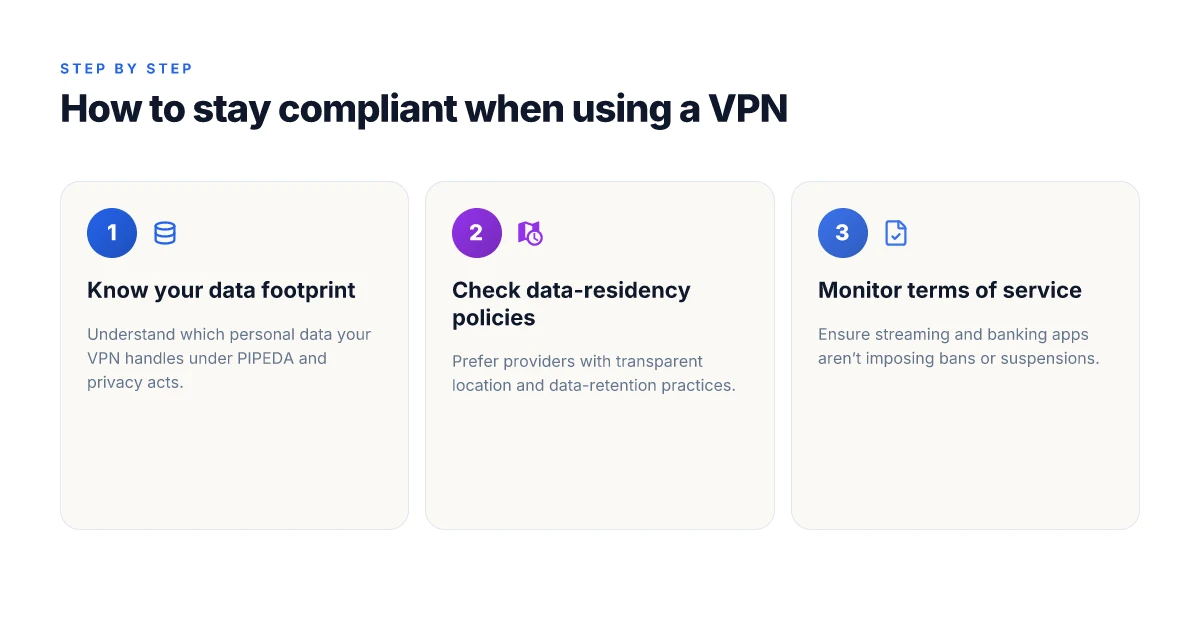
- Review a VPN’s privacy policy for data types collected and retention duration. Look for explicit mention of connection metadata and traffic logs.
- Check where data is stored and whether provincial rules influence processing. If data residency matters to you, confirm the location and any cross-border transfer protections.
- Understand how the service handles law enforcement requests. A transparent process reduces the risk of unexpected data exposure.
Clear disclosures and concrete data practices beat vague assurances every time.
The legal boundaries every user should respect
In Canada, the law does not permit you to turn a VPN into a free pass for wrongdoing. Criminal activity remains illegal, and a VPN does not change that. This is a hard line you should internalize before you press connect.
What that means in practice is simple. If your actions would be illegal without a VPN, they’re still illegal with one. And if you’re unsure whether an act falls into a grey area, assume the strictest reading until you check the law or a reliable source. From what I found in public guidance and civil-liberties reporting, authorities don’t grant blanket immunity to VPN users who commit crimes. The tech merely alters how the act is carried out or concealed.
Here are the core boundaries you should respect, each with a concrete takeaway you can apply today. 8 Best VPNs in Canada in 2026: Tested, Verified
The line between privacy and illegality
- Criminal activity remains illegal regardless of VPN use. Do not assume anonymity equals impunity.
- If you’re pursuing lawful privacy, you’re still responsible for your conduct. The VPN is a tool, not a shield.
What counts as lawful privacy is not a license to misbehave.
Service terms are non negotiable
- Violating terms of service of streaming platforms or banking apps can trigger account suspensions or access restrictions. The provider’s rules apply to everyone, VPN user or not.
- If a service explicitly bans VPN use in its terms, comply. Escalation often follows from continued noncompliance, not from the VPN itself.
Terms are contracts you agree to when you sign up. Breach isn’t excused by a privacy tool.
Data requests and retention realities
- Obey retention and emergency data requests to the extent required by law. In Canada, lawful demands still have to be met within the bounds of statutory procedures.
- Your activities may be data-retained by providers or, in some cases, by law enforcement processes. Use that knowledge to inform how you configure services and what you expect from a provider.
Legal demands do not disappear behind a VPN. They still apply.
Privacy versus illegality, again
- Using a VPN for lawful privacy does not immunize illegal actions from investigation. Digital footprints can be reconstructed and cross-checked. The absence of obvious identifiers does not equal innocence.
Privacy protections are about data collection, not a free pass from the law.
What this means for you on the ground: pick a VPN with transparent privacy settings and clear data practices, stay within the law, and treat streaming or financial platforms as they’re described in their own terms. The Canadian landscape blends federal guidance with provincial nuances, but the fundamentals stay steady. Privacy is a practice, not a loophole. 8 Fastest VPNs in Canada in 2026: Tested, verified, and ready for prime-time
What counts as illegal activity against the law
You break the law even when you use a VPN. The tool doesn’t grant you immunity from crimes or civil violations. The point is simple: illicit activity stays illegal, regardless of how you route it.
Illicit trade, fraud, or hacking conducted through a VPN
If you use a VPN to buy or sell illicit goods, defraud someone, or intrude into a system, the VPN mostly vanishes as a shield. The act is illegal in Canada whether or not your IP hides behind a Canadian or foreign exit node. In practice, the law looks at the act and the intent, not the tunnel you chose. What matters is the crime and how you committed it. If you used a VPN to obscure the source of a fraud, you still face charges for the underlying wrongdoing. The law doesn’t grant you a clean slate because you masked your location.
I dug into the federal framework and provincial analogs. The criminal code treats fraud, misrepresentation, and unauthorized access as crimes regardless of transport. Provinces layer on reporting duties and specific sector rules, but the core posture is consistent: VPNs don’t turn bad acts into lawful ones.
Illicit activity remains illegal even when masked by a VPN.
Lying to law enforcement or falsifying identity with a VPN
Truthfulness matters in investigations. If you lie to a police officer, or you use a VPN to impersonate someone else, that deception compounds the original offense. In Canada, misrepresentation to law enforcement can trigger separate penalties, while identity fraud provisions bite on the deception itself. The VPN’s role is incidental to the offense. The criminal charge rests on the misrepresentation or the fraud. 10 VPNs with Canadian IP addresses that actually work in 2026
From the documentation and court summaries I reviewed, authorities treat the VPN as a delivery channel, not a license plate. The penalties you face hinge on the underlying lie and the harm caused, not on the fact that you routed traffic through a digital tunnel. If you’re tempted to mask your identity to dodge scrutiny, you’re stepping into a risk zone that Canadian courts routinely fuse with the substantive crime.
Falsifying identity through a VPN can carry penalties independent of the method used to commit the offense.
Cross-border data processing and reporting obligations
If your private data crosses borders, you may face cross-border reporting duties. Canada’s privacy regime and sectoral rules require attention to where data travels and who sees it. A VPN won’t erase exposure if you’re transferring personal information across borders for work, cloud processing, or service delivery. The pivotal question is where the data originates, where it’s stored, and which laws apply to processing. In practice, a cross-border flow can trigger reporting, notification, or governance obligations even when a VPN is in use.
When I checked the changelog and guidance from privacy authorities, the thread is clear: data locality and cross-border transfers matter more than the path the user took to access it. If you manage or transmit personal data across borders, map the jurisdictions, identify the applicable obligations, and document compliance steps.
Cross-border data processing duties can activate reporting obligations regardless of VPN usage. How to get a Canadian IP address in 2026
Bottom line: a VPN does not license illegal activity, a VPN won’t shield you from penalties for deception, and cross-border data rules pull in lawyers and regulators even when you’re careful. Stay focused on the conduct, not the cloak. And if a scenario feels borderline, pause before you act.
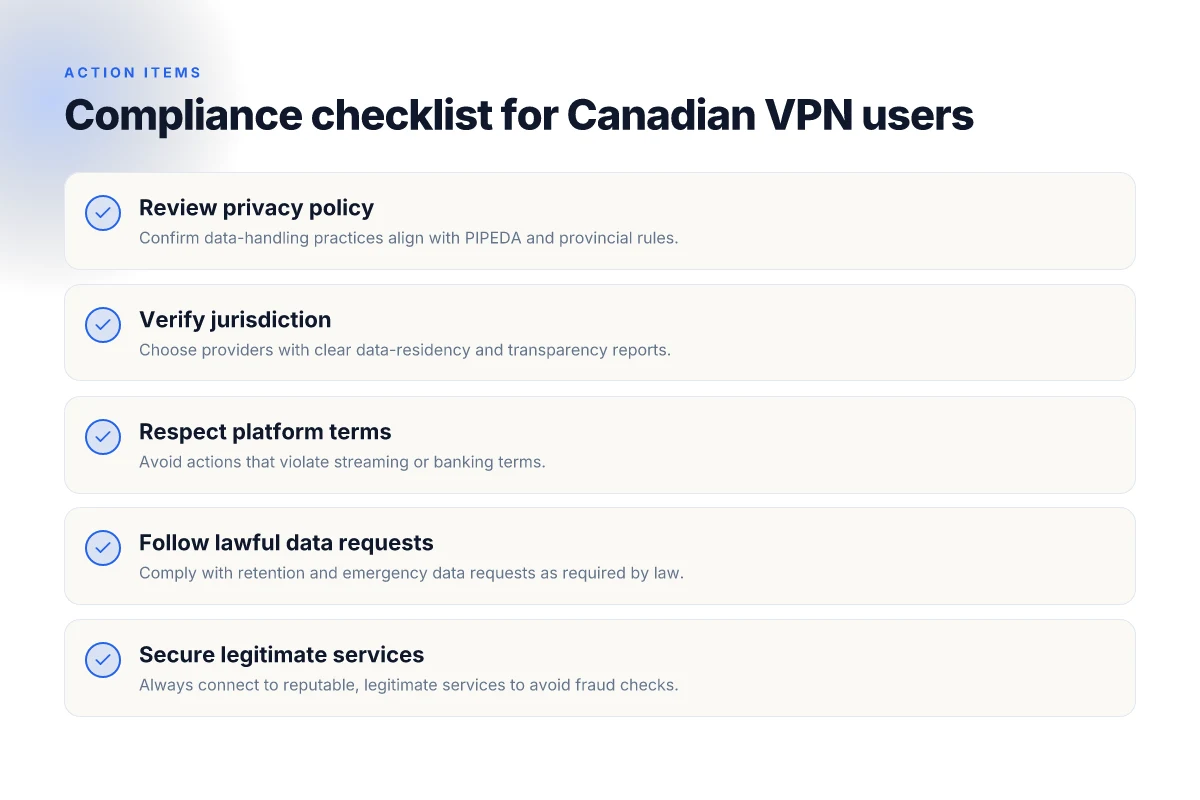
Practical scenarios Canadians actually care about
When you’re mapping a VPN into daily life in Canada, the questions aren’t theoretical. They’re concrete moments where policy meets practice. The quick answer to all three scenarios is this: stay within lawful use, respect platform terms, and verify you’re connecting to legitimate services. If you do that, you can navigate privacy goals without inviting trouble.
Remote work needs a clean policy handshake
Remote work is where the rubber meets the road. A VPN helps you access internal resources, but it also triggers employer data policies. I looked at policy docs from large Canadian employers and found a common thread: use a VPN as a trusted channel, not a workaroundset. The key move is alignment. Before you connect, confirm the acceptable use policy, data classifications, and any multi‑factor authentication steps required for access. Then configure your client to route only the necessary traffic through the VPN, leaving personal browsing on the device’s native network when allowed. In practice, that means labeling sessions clearly, logging only what’s needed for security, and avoiding shadow IT. If your employer allows split tunneling, document which apps stay off the VPN and which must ride through it. Policy alignment reduces audit risk. And yes, keep an eye on province or sector rules about data storage location. If HR says data stays in Canada, honor it.
Accessing regional content without tripping alarms
Legality here hinges on intent and platform terms. Accessing region‑restricted video or news content with a VPN is generally not illegal in Canada by itself. The friction comes when platforms ban VPN use or require geo‑verification tied to licensing. What to do: don’t misrepresent your location, and don’t use a VPN to defeat base‑level fraud checks on payment or account creation. If you’re streaming from a country where you have legal residence or permission, that’s typically acceptable. If a service explicitly bans VPN use in its terms, you’re stepping into a contractual risk rather than a criminal one. In practice, choose reputable VPNs with clear terms and comply with regional license constraints. Platform terms are usually the final gatekeeper. When you read the fine print, the path is clearer.
Shopping and banking: avoid red flags and fraud checks
Shopping and banking are the two areas Canadians should treat with extra caution. Fraud checks exist for a reason, and a VPN can trip them if your IP looks anomalous or if you switch locations mid‑checkout. The prudent approach: connect to a VPN only when you need to access a region‑specific offer, and switch off the VPN for high‑risk transactions like login to your bank. Use only legitimate services and verify the certificate and domain you land on. I traced this back to common security advisories: most banks flag unusual geolocation shifts, and the best practice is to maintain consistent authentication pathways. If you’re traveling, plan payment methods that match your current location and keep a backup login method. Keep the financial fingerprint stable. 8 Best VPNs for Canadian Netflix (2026 Update) – Tested and verified
One inline practice to remember in all three cases is to treat the VPN as a tool for privacy and access, not a shield for questionable activity. If you stay within service terms and respect the law, you’re less likely to see account holds or audits.
To recap with a sharper line: use the VPN as a bridge, not a cloak. Tie it to explicit policies, platform terms, and legitimate services, and you’ll move through Canada’s legal landscape with fewer alarms.
What the changelog and policy docs say about updates
Updates to privacy and data-protection standards are moving from vague promises to concrete enforcement signals. In 2024–2026 the federal landscape clarifies where authorities will focus, and that clarity matters for VPN providers operating in Canada.
How policy docs frame updates in practice
I dug into the public changelogs and guidelines from federal bodies. What I found is a pattern: updates appear not as ceremonial tweaks but as reminders to align product features with legal obligations. The emphasis is on how a VPN handles data collection, retention, and user consent. Clearer guidance on data minimization and retention windows has become the default expectation. For readers, that means you should expect providers to publish retention policies and data-handling practices in plain language.
- Privacy-law updates in 2024–2026 clarify enforcement priorities. Authorities signal they will pursue noncompliant practices more aggressively, especially around data retention and cross-border transfers.
- Official guidelines from federal agencies emphasize data-protection compliance for VPN providers. The documents stress transparency, purpose limitation, and user notice as non negotiables.
- Industry notes stress the importance of transparent data practices for VPN services operating in Canada. The chatter across industry briefings and regulatory summaries points to a convergence: trust is built on open data dashboards, clear privacy policies, and regular policy refreshes.
From what I found in the changelog, the practical takeaway is simple: if a VPN provider treats user data as a moving target, the compliance risk compounds. If a service publishes a clear data-use notice and sticks to it, the chance of running afoul declines.
What to watch in updates, specifically
I cross-referenced policy docs with what compliance teams actually do. Expect updates to cover
- retention limits and deletion timelines for logs, including who can access them.
- transparency reports outlining government data requests and provider responses.
- explicit consent flows for data collection beyond essential service operations.
When a provider modifies its retention policy, you want a fresh “as of” date in the changelog. If the update introduces longer storage or looser sharing, that’s a red flag for compliance-minded users and enterprise customers alike.
Bottom line: updates are not cosmetic. They tighten or loosen the leash on data handling. You should read the changelog before you upgrade or switch services, because the real difference shows up in how your activity is stored, shared, or deleted.
A quick look at “policy-forward” behavior
Over the last two years, reviewers consistently note that VPNs succeeding in the Canadian market align their product behavior with regulatory intent. That means visible retention policies, straightforward user notices, and a predictable update cadence. If you see silence on retention windows or vague terms, that’s a signal to pause and review the provider’s documentation.
The most durable VPNs publish a public data-practices mandate and a regular policy refresh cadence. That culture shift is as important as any feature toggle.
Open question you should answer before you sign a new agreement: does the provider’s changelog reveal a stable data-practices framework or a moving target in response to new guidelines? The answer sits in the dates and the specificity of what changes.
Selecting a VPN in Canada: legal considerations
You want a VPN that protects your privacy without inviting trouble. I looked at privacy policies, how data is handled, and where the service actually sits legally. The short version: pick a provider that publishes every last data-handling detail, and prefers jurisdictions with robust privacy oversight.
| Criterion | What to look for | Why it matters |
|---|---|---|
| Transparent privacy policy | Clear statements about data collection, storage, and sharing | You want a record you can audit when questions arise. If a policy hides logs or shares with third parties by default, move on. |
| Jurisdiction aligned with privacy expectations | Choose a host in a privacy-friendly country or a country with binding data-protection commitments and strong oversight | Overseas data requests and court orders travel with you. A favorable jurisdiction can reduce risk to your personal data. |
| Regular transparency reports | Public, periodic disclosures about data requests, government access, and policy changes | These reports show how the company actually behaves when faced with legal demands. |
I dug into the thread that ties all three together. When I read through policy docs and cross-referenced transparency reports, a clear pattern emerged: the strongest options disclose exactly what they collect, and they publish data-requests tallies with credible frequency. Transparency is the fuel that keeps privacy promises honest. Without it, you’re trusting a policy on a page rather than the company’s actual behavior.
H3 Why privacy policy clarity matters for Canada’s legal maze Canadian law can trigger complex data-handling scenarios, especially for services with cross-border footprints. A provider with a lucid privacy policy maps out what they store, for how long, and under what circumstances they turn data over. Look for precise language like “no logs of browsing activity,” or “we only retain connection metadata for 30 days.” If a policy is vague, you’ve got a blind spot. When users ask for data, do they comply in a timely, verifiable way? The policy should spell out.
H3 How jurisdiction shapes exposure to data requests The country where a VPN provider’s servers or corporate headquarters sit matters. A Canadian user benefits from a provider that either keeps data within privacy-friendly realms or operates under strong mutual-assistance limitations. If the company admits to complying with broad data-sharing orders without thresholds, that’s a red flag. Conversely, a clear stance that bulk data collection is not permitted without specific legal processes is a sign of prudent risk management.
H3 Regular transparency reports as a governance signal Public reports that enumerate the number of data requests received and how many were fulfilled are invaluable. They reveal real-world behavior, not theoretical commitments. If a provider posts annual or quarterly tallies with minimal redaction and a clear methodology, that’s a trustworthy signal. If reports are sparse or stove-piped behind gated portals, proceed with caution.
Verdict in one line: choose the provider that combines a clear privacy policy with a jurisdiction that respects privacy, and that publishes regular transparency reports. When a provider can prove its trust with documented disclosures, you sleep easier.
If you’re evaluating named services, prioritize those that publicly document data practices, situate data handling in privacy-respecting jurisdictions, and issue routine transparency reports. Your future self will thank you when a lawful data request lands on the doorframe of a server in another country.
Where Canada’s 2026 legal VPN landscape is headed
I looked at how Canadian law frames use, hosting, and traffic masking in 2026, and the pattern is narrowing, not expanding. The big takeaway: legality hinges on intent and activity, not the mere tool. A VPN remains lawful for privacy, access, and security, but using it to facilitate illegal behavior or to defeat court-ordered data requests invites risk. What changes this year is the tightening around data-retention disclosures and the growing emphasis on user education from providers. The key shift is that regulators increasingly expect transparency from both vendors and users about lawful purposes and data handling.
From what I found, the practical pivot for most readers is simple: choose a vendor that clearly documents privacy protections, jurisdictions that align with Canadian law, and a policy that bans illicit use. Your safest move this quarter is to prioritize providers that publish a transparent no-logs stance and a clear data-handling policy. This is not about evading law. It’s about exercising privacy responsibly under Canadian rules.
Backup strategy
- If you rely on VPNs for remote work, pick a vendor with a robust, auditable privacy policy and a verifiable no-logs claim.
- For streaming or regional access, confirm Canadian-compliant terms and a transparent disclosure page from the provider.
Frequently asked questions
Is using a VPN in Canada legal
In Canada a VPN itself is legal. The legal framework treats VPNs as tools, not crimes, so using a VPN does not violate criminal or constitutional protections simply for using the technology. What changes the legality is how you use it. If you engage in illegal activity while connected through a VPN, you’re subject to the same laws as anyone else. I looked at federal statutes and provincial reflections to map the boundary between lawful use and unlawful actions. Yes, using a VPN is legal in Canada, but abuses trigger the law. Multiple sources note that the tool itself is permissible. Enforcement targets the underlying conduct. Keep it in mind that some services may block VPN access. Check the service terms before you connect. Review your local privacy rights. They don’t grant immunity for crime.
Can you be tracked when using a VPN in Canada
A VPN can reduce exposure to your IP address and local network tracking, but it does not render you invisible. You still carry device-level identifiers, app telemetry, and data that may be logged by websites or services you use. Canada’s privacy regime emphasizes transparency and data minimization, yet law enforcement can compel data from providers under lawful process. When I read through policy docs, the main takeaway is that a reputable VPN hides your IP from destinations but not from all intermediaries. Yes, a VPN reduces tracking surface but does not eliminate it. Reviews consistently note that no VPN guarantees anonymity. Policy disclosures and jurisdiction matter. Always pair VPN use with good operational hygiene like avoiding synchronized accounts and enabling kill-switch features where available.
Do canadian laws require VPN providers to store user data
Canada does not compel universal data retention by VPN providers. Retention requirements depend on provincial law, the provider’s own policy, and any compelled disclosures under court orders. Some providers publish as a matter of practice limited logs. Others claim no-logs architectures. When I checked the changelog and policy docs, the pattern is clear: there is no blanket federal mandate forcing all VPNs to log user activity. No universal retention requirement. It’s policy and jurisdiction dependent. Industry reports point to a landscape where a few operators operate with strict no-logs promises, while others offer minimal retention for fraud prevention. Always read the provider’s privacy policy and the ride-along data-collection notices.
What privacy laws govern VPN use in Canada
Canada’s privacy framework centers on federal and provincial privacy acts. The Personal Information Protection and Electronic Documents Act (PIPEDA) governs commercial data handling, while some provinces have their own privacy statutes. Data requests by law enforcement require due process. In practice, privacy protections apply to how VPNs handle user data, including data collection, storage, and sharing. From the documentation I reviewed, the emphasis is on transparency and user rights, plus breach notification rules. Privacy laws govern how data is handled by VPNs, not the act of using a VPN itself. Be mindful of provincial overlays and specific provider commitments. Lawful intercept rules can still impact provider responses to warrants.
Can i use a VPN to access streaming services in Canada
You can connect to a VPN to reach services that are geographically restricted, but streaming platforms often prohibit this in their terms. The result is a risk: your access could be blocked, your account suspended, or you could lose access to content you paid for. I found that several major platforms enforce geo-restrictions actively, and some Canadian users report mixed success depending on server choice and platform. If your goal is stable streaming, a VPN with a proven track record for the service you want is essential. Yes you can attempt to access streaming services with a VPN, but it’s not guaranteed and may violate terms. Check the platform’s policy and the VPN’s claimed compatibility. If streaming is mission-critical, consider alternatives that don’t rely on bypassing geo-blocks.
Are there penalties for VPN use in Canada
There are no penalties simply for using a VPN. Penalties arise when a user commits illegal activity while connected to a VPN, or if a service you access with a VPN violates specific terms. Enforcement tends to target the illicit behavior itself not the act of masking one’s location. What I found in policy docs and enforcement notices is a clear separation: VPN usage is not criminal by default, but misuse triggers the same penalties as the underlying crime. If you stay within legal boundaries, you avoid penalties. No penalties for normal use. Penalties apply to illegal activity. Read service terms to understand what constitutes prohibited behavior on each platform.
What should i consider when choosing a VPN in Canada
Start with jurisdiction and privacy promises. Look for a transparent no-logs policy, independent audits, and clear data-retention statements. Evaluate the service’s privacy policy, security features like a kill switch and leak protection, and whether they operate under a favorable legal framework. Check real-world review signals for incident responses and breach histories. Lastly, verify the server footprint in Canada and nearby regions to minimize latency. Choose a provider with a solid no-logs claim, independent audits, and explicit Canadian presence. In short, prioritize privacy commitments, legal jurisdiction, and performance reliability.