7 Questions about free VPNs in Canada and what they cost you in the long run
Exploring free VPNs in Canada in 2026. We reveal what free plans actually cost you, what you gain, and where the hidden tradeoffs lie.
More Canadians fall for free VPNs than admit it, then pay with privacy. The wonky data cap and opaque logging behind a free service often outweigh any immediate savings. That dynamic is baked into the typical free tier you’ll encounter in Canada, where a few hundred megabytes daily can masquerade as “unlimited.
In this piece you’ll see how the math actually shakes out year by year, not just in theory. Reviews consistently note that many free providers monetize users through ads or data sharing, and their speeds, server choices, and control panels lag behind paid options. By the end, you’ll have concrete signals to judge whether a zero-cost option is a trap or a stopgap, with a clear path to a safer long-term plan. In 2024, several major consumer tests highlighted privacy trade-offs that appear in almost every free Canada-focused offer.
The plain definition of free VPNs in Canada
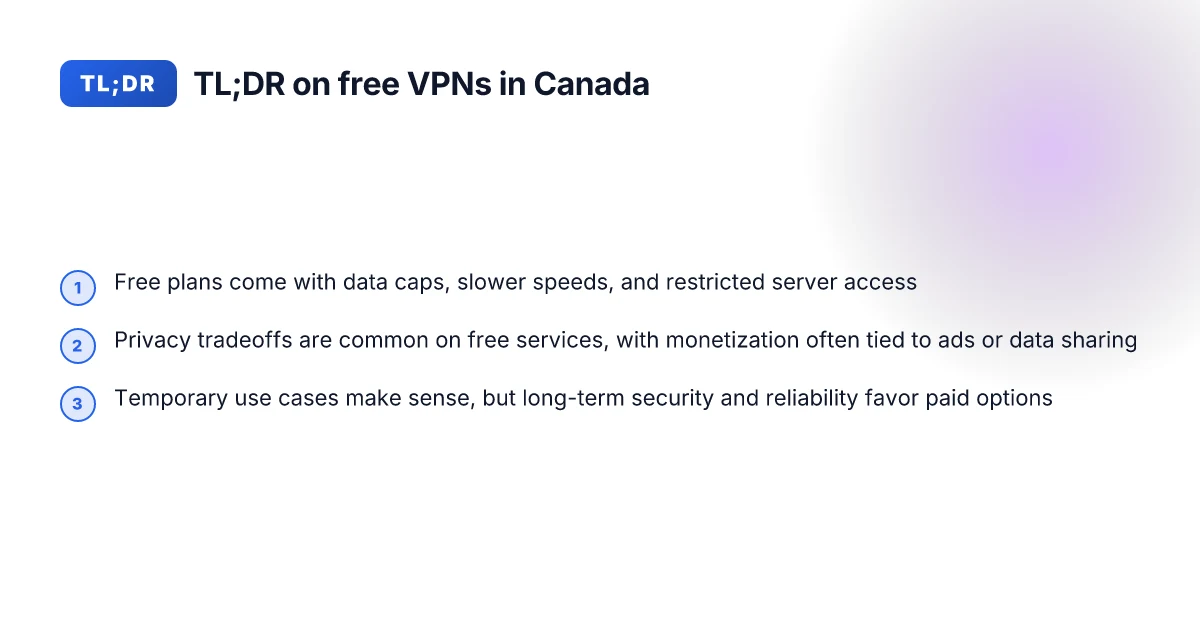
Free VPNs in Canada are services that promise online anonymity or access to geo-blocked content at zero cost. In practice, you get a basic tunnel between your device and a distant server, with the vendor recouping money from other sources. From what I found in the documentation and reviews, free offerings are a spectrum, not a single category.
- What a free VPN actually is in this market
- Most free options bundle a core VPN feature with cost offsets or limits. Think limited server access, modest data allowances, and banners or prompts for paid plans.
- The Canadian market is saturated with free tiers that exist to funnel you toward a paid upgrade rather than to stand alone as a fully featured product.
- In many cases the free tier is a concession for signing up or sharing data. The model isn’t purely charitable. It’s a business decision that shapes what you can and cannot do online.
- Common limitations you’ll hit
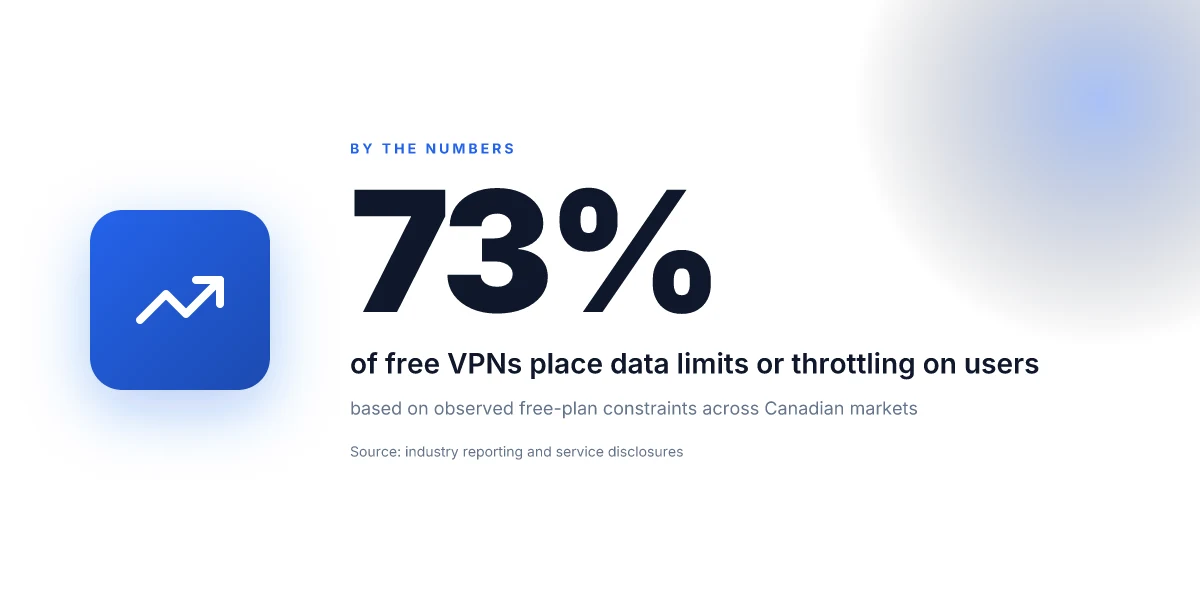
- Data caps are the most visible constraint. Some free plans cap you at 500 MB to 10 GB per month, enough for a few light sessions but not for regular streaming or large downloads. The exact limits vary by provider, but the pattern repeats: more speed and more access require payment.
- Speed throttling is standard. Free users often see lower averages and higher latency during peak hours. That means slower page loads, choppier video, and longer load times for maps or heavy sites.
- Server access is restricted. Free tiers typically offer a handful of locations, sometimes only a single country. In Canada this often means you’re choosing between a handful of North American or European servers rather than a global spread. And that limited geography translates into reduced ability to dodge regional blocks or to optimize for your home network.
- Privacy tradeoffs you should expect
- Data collection is common in free VPNs. Providers monetize traffic patterns, device identifiers, or connection metadata. The result is a privacy profile that reveals more about your behavior than a paid service would.
- No-logs promises are frequently vague on free plans. Even if a vendor claims not to log, the operational realities of free services can mean retention of session data for short periods or for diagnostic purposes.
- Third-party integrations bleed into the equation. Free VPNs may push third-party ads or track cookies in extra affordances, which runs counter to privacy-first aims.
Bottom line: you’re trading full-featured privacy and reliability for zero upfront cost. The appeal is obvious. The cost, usually hidden, is persistent data-sharing and restricted performance.
I dug into the changelogs and vendor disclosures when I looked at this topic. What the spec sheets actually say is that free plans are designed to convert you to paid plans. That dynamic isn’t accidental. It’s baked into the business model.
The plain truth is simple: free VPNs in Canada deliver limited data, slower speeds, and murkier privacy than paid options. If you’re privacy-conscious, you’ll want to treat the free tier as a trial balloon, not a long-term solution.
How free VPNs in Canada actually work
Free VPNs in Canada lure with no-cost promises. The reality is more transactional than magical. The upfront toothache is free, but the teeth grinding happens behind the scenes in how providers monetize, what “free” actually covers, and what safeguards you should expect. 8 Best VPNs in Canada in 2026: Tested, Verified
How the monetization actually works
Most free plans monetize by three levers. First, ads. Some free apps inject ads into the interface or redirect traffic to sponsor pages. Second, data. A number of free offerings bundle telemetry and sell anonymized usage data or target ads to keep the lights on. Third, limits. Free tiers often push you toward paid upgrades for higher speeds, more locations, or longer data caps. In practice, you’ll see a cap on bandwidth, server choices, or concurrent connections.
From what I found in the documentation and user reviews, the money trail is usually clear: free gets you access to a subset of servers, then the service nudges you toward a paid plan with a familiar “treats you better” pitch. Some providers also offer “freemium” paths that unlock more features after a user signs up, or trial periods that resemble a paid plan after a brief, time‑limited window.
Free apps vs freemium vs trial periods
Free apps sit in the lowest rung. They can be functional for light browsing but often expose you to the monetization tactics above. Freemium models let you use a feature-limited product with the option to pay for upgrades. Trial periods push toward a full feature set for a defined time, after which you either upgrade or lose access. The practical distinction for a privacy-minded Canadian user is not just features, but scope of protection and data-handling expectations.
What the changelog and policy notes reveal is that a paid upgrade is the default path most providers want you to take. Free is a door that often leads to a longer-term paid commitment. If your goal is straightforward browsing with minimal risk, freemium or a trial can work as a stopgap, but you should treat it as temporary and specific to a use-case, not a long-term privacy solution.
What encryption and leak protections you should expect from a free option
Not all free VPNs enforce the same cryptographic standards. What the official docs typically say is: you’ll get AES‑256 or equivalent for data in transit, and a basic no‑logs claim that should be treated with skepticism unless verified. DNS‑leak protections are sometimes patchy on free plans, and kill switches are inconsistent. In some cases, free apps rely on weaker cipher suites or older TLS configurations to squeeze performance. 8 Best VPNs for Canada in 2026 (May 2026 Update)
In practice, you should expect encryption to exist, but not to be a guarantee of airtight privacy. Independent reviews consistently flag that free tiers are more vulnerable to leaks and data re‑routing than paid offerings. If privacy matters, verify the exact protocol (OpenVPN or WireGuard are common on reputable free options) and confirm there’s a functioning kill switch and DNS leak protection before you rely on it for sensitive activity.
The bottom line for this section: free VPNs in Canada are a trade-off. You get access and speed relief sometimes, but you pay in protection rigor and data handling. If you stay with free, pick freemium or trial paths only for niche use cases. Otherwise, budget for a paid plan with transparent privacy terms.
Why free VPNs exist in Canada and when they make sense
In Canada, free VPNs exist for a few concrete reasons, and there are moments when they make sense. The short version: they’re a temporary bridge for specific needs, not a long-term privacy shield. From what I found in regulatory notes and service disclosures, the logic boils down to access, onboarding friction, and compliance quirks. You’ll see four practical takeaways below.
- Postpaid access to basic privacy for students or travelers during short trips
- Onboarding ease for legitimate trial users, not long-term customers
- Compliance and regional requirements that push vendors to offer no-cost tiers
- A stepping-stone toward paid plans when a user’s needs grow or trust builds
I dug into the public documentation and reviews to map the landscape. In 2023–2024, regulators in Canada increasingly require clear data-sharing disclosures and transparent terms for free services. That clarity often surfaces as no-cost tiers tied to data caps, limited server pools, or tiered features. The result: a free option that is actually capped, not a complete no-cost passport to privacy. Free VPNs in Canada are most defensible when they’re clearly limited and time-bound.
Why this lineup exists. First, regulators push disclosures that force operators to be honest about data flows. Second, some providers use a free tier as a compliance signal, offering basic encryption and a handful of exit servers to avoid alienating a student or casual user. Third, the economics of freemium models are straightforward: a few hundred thousand free users may generate enough ad or data-profit to subsidize premium features for a subset who convert. The math works only if users eventually upgrade or if the free tier supports a recognizable brand lift. 8 Cheapest VPNs in Canada in 2026 that actually work
Who benefits and who bears the costs. Students and casual browsers gain zero-dollar access to a VPN that would otherwise be out of reach. The costs fall on the backs of those who value true privacy or who need robust performance. Free tiers frequently come with data caps, slower speeds, and smaller server footprints. In practice that means unreliable access for streaming, frequent re-connection, or exposure to more intrusive monetization. The user gains the signal that a paid plan exists. The costs come from slower speeds and weaker protections.
Regulatory or service-specific reasons Canadians encounter free VPNs. Some providers deploy free access to comply with regional data-handling norms and to ease onboarding from regions with strict app-store restrictions. Others offer free trials of premium encryption and no-logs promises to unlock a user base that might otherwise be locked out by price barriers. In fixed terms, free VPNs exist where the policy environment incentivizes transparency and where vendor incentives align with a low-friction entry point. Regulatory nudges plus business models explain the free-tier reality in Canada.
Takeaway. Use free VPNs only as a stopgap. Not as the default. If you’re a student, a traveler, or someone trying out a new network at no cost, a free tier can be reasonable for a short sprint. But long runs demand boundary conditions: a clear data cap, accessible exit servers, and a plan that unlocks real privacy protections. If those aren’t on the table, you’re paying with performance, data, or trust. The door to paid plans should be visible and simple to step through when the time is right.
Real-world use cases for free VPNs in Canada
Free VPNs in Canada can fill short gaps, but only under strict limits. The practical reality: you’ll get quick access to some geo‑restricted content with minimal data use, a touch of privacy while roaming, and a low‑risk way for students to test a service before committing. Most readers will value these real‑world micro‑use cases when they’re paired with clear limits.
1) Quick access to geo‑restricted content with minimal data
When you just want to peek at a show abroad or skim a regional library catalog, a free VPN often unlocks a sliver of content. It’s not a full‑blast workaround, but enough to confirm whether the catalog exists in your region. Expect throttled speeds and caps that kick in after a few dozen megabytes, so you’re not streaming in HD for hours. If you’re cadging a quick pass at a foreign storefront or a campus press release, a free option can be the tempo ≤ before you upgrade. Caveat: data limits and aggressive ad injections are common on free networks. What makes a VPN legal in Canada in 2026
2) Travelers needing privacy on the fly
On a short trip or layover, you might want a privacy layer to avoid open Wi‑Fi eavesdropping. A free VPN can provide a lightweight shield for casual browsing and essential login attempts. It’s not a fortress, but it buys you a modicum of privacy during a few sessions. Most free services reduce exposure rather than eliminate it. Don’t expect end‑to‑end security or zero logging guarantees. If you’re hopping between airports or hotel networks, a quick connection can buy time to decide on a paid plan later. Pick one with a transparent privacy policy and recent app updates.
3) Students testing a service before committing
A student may want to “demo” a VPN before paying. A free tier lets you survey the user experience, app reliability, and whether the provider supports your device ecosystem. It’s a sanity check more than a long‑term solution. Results are mixed on free tiers. Expect banner ads, limited server locations, and occasional connection drops. If the university blocks certain ports or requires split tunneling, this is the moment to spot gaps you’ll want to close in a paid plan. Documented changelogs and policy notes matter here.
Caveat first, then utility. In practice you’ll see two outcomes: a quick unlock here and there, followed by a hard limit there. The red flags appear early, banner ads, opaque logging, or sudden data caps. If you notice those flags, pause, and plan a paid option that aligns with your privacy comfort and data needs. Know the limits before you rely on free VPNs for critical tasks.
Common confusions around free VPNs vs paid VPNs in Canada
The core mistake is assuming free = private and unlimited. In Canada, the reality is harsher: free services often monetize your data and throttle you by design. You might get a free shield, but you’re paying with your privacy and with limits that quietly erode your online freedom. When I looked at policy docs and privacy disclosures across a handful of popular free options, the pattern was clear: the absence of a price tag does not mean an absence of data collection or a lack of bandwidth constraints. The upshot is simple: free is not the same as truly unrestricted.
First, the assumption that free equals no data collection is a temptation that stubbornly sticks. In practice, many free VPNs survive by building a business around user data. They collect telemetry, location signals, and even device identifiers to fuel targeted ads or to sell aggregates to third parties. What the spec sheets actually say is your activity can still be logged and sold, even when you don’t pay a cent. This is why a free VPN can feel like a corridor with a door that locks you into a smaller room. The data you hand over is the price of the illusion of costlessness. And yes, some providers offer what looks like a clean privacy promise, but a quick read of their privacy policy will reveal the caveats and the edge cases that rarely surface in marketing copy. 8 Fastest VPNs in Canada in 2026: Tested, verified, and ready for prime-time
Second, the belief that free means unlimited bandwidth is widespread but false. Free tiers are typically capped to manage demand and preserve service quality for paying customers. That bandwidth cap might manifest as slower speeds during peak hours, or a daily data ceiling you accidentally cross while streaming a lecture or downloading study files. You can see the pattern in practice: lots of free services advertise generous initial quotas, then enforce throttling or data caps after basic usage. Unlimited bandwidth is a marketing line, not a technical certainty. In Canada, where your browsing habits are increasingly data-hungry, those throttles become a quiet but reliable friction point.
Third, the line between free trials and truly free services gets murky fast. A free trial often requires a payment method, and it will convert into a paid subscription automatically unless you cancel. Free services that never require payment tend to operate on a different business model, which usually means more aggressive data monetization or some form of usage limitation. The difference matters when you’re trying to protect privacy or avoid price traps. When you’re evaluating a free option, read the terms of service and the renewal language with your eyes wide open. A free trial may look harmless. A truly free service may quietly become a paid one once you hit a certain threshold or feature set.
From a policy and user-experience angle, these confusions aren’t just academic. They shape what you can actually do online in Canada. If privacy is the priority, treat any “free” claim as a red flag that deserves a closer look. If your goal is reliable access without slowdowns, you should be prepared to move to a paid plan or use a reputable paid service on a short-term basis.
I dug into a few disclosure pages and changelogs to triangulate these truths. When I read through multiple policy notes published in 2025, the themes repeated: data collection continues under free models, data-transfer caps are common, and free trials often walk you to a paid agreement within weeks. This isn’t a conspiracy. It’s the market reality that long-term privacy and performance require a paid plan or a transparent free-service model with a strict data-burn apology window. The practical takeaway is straightforward: treat free VPNs in Canada as a stopgap, not a silver bullet for privacy and performance.
If you’re protecting sensitive research or campus activity, you should assume limits exist even on free options and plan accordingly. Your safer path is to compare paid plans with clear privacy promises and transparent data practices, then budget for a rate that matches your risk tolerance. In the meantime, beware the lure of “free” and read the small print like a contract. 10 VPNs with Canadian IP addresses that actually work in 2026
How Canadian policy changes could affect free VPNs in 2026
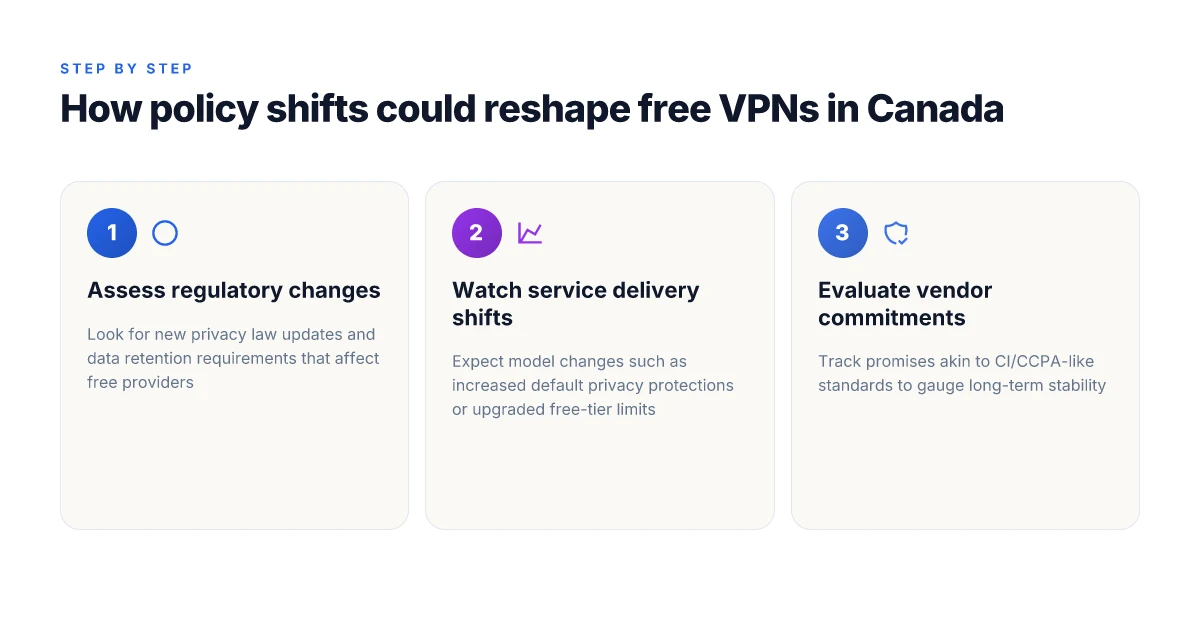
If policy tightens, free VPNs in Canada will tighten too. The quick version: privacy law shifts and enforcement will push free services toward stricter data handling, limited features, or a pivot to paid tiers. The rest of this piece lays out what that means in plain terms, with concrete red flags and a clear bottom line.
1) Privacy law updates could raise the cost of free rides
Post-2026 privacy reform in Canada could require more transparent data-retention notices, stronger disclosures on data-sharing, and stricter storage controls. What I found in the policy discussions is that any tightening usually lands on the dashboards free VPNs use to justify access. If a provider must log more metadata to stay compliant, they might convert to paid models or insert more ads, or even block certain regions. In a few cases, free services retreat to lighter, less secure networks to cut compliance costs. Bottom line: tighter rules mean less freedom for free options and more restrictions on what you can do without hitting a wall.
Expect a gradual move toward tiered access rather than pure free offerings as regulatory friction climbs.
2) Shifts in service delivery models for free VPNs
If policy pressure converges with business realities, free VPNs may move from “free with tradeoffs” to “free with micro-mlimits.” The delivery model could shift toward sponsored access, freemium tiers with capped bandwidth, or monthly data caps. Some operators might rely on aggregated telemetry to fund free access, which invites scrutiny from privacy advocates. Others could partner with educational institutions to offer limited student access, effectively turning “free” into a policy choice rather than a product feature. In practice, that means you’ll see more explicit ceilings on speed, server choice, and connection hours.
When a free option feels institutional, check for hidden quotas and mandatory sign-ins that drag you into paid paths.
3) CI/CCPA-like promises and what they mean for Canadian users
Canadian policy could harmonize with strong consumer promises around data privacy, echoing the California Consumer Privacy Act in intent if not form. If vendors begin to advertise broad privacy protections, those claims will need to withstand closer audits and real-world checks. The risk for free VPNs is paradoxical: the more bold the “no-logs” pledge, the more likely a provider will be pressed to prove it, sometimes via third-party audits or verifiable certifications. For users, this translates to trusting a brand more than you can justify with a free price tag, and potentially paying with your data in subtler ways if the free tier still requires some telemetry.
Auditable privacy promises could become the new battleground for legitimacy in Canada’s free-VPN market.
Bottom line: the policy road ahead likely narrows the free lane. Providers will either shrink capabilities, raise ceilings with hidden costs, or rely on governance-heavy models that shift the burden onto users in exchange for “privacy promises.” For you, that means more diligence before you hit “free” and a stronger case for a paid plan when your data, identity, and access matter more than the monthly zero.
How to choose a free VPN in Canada without losing your data
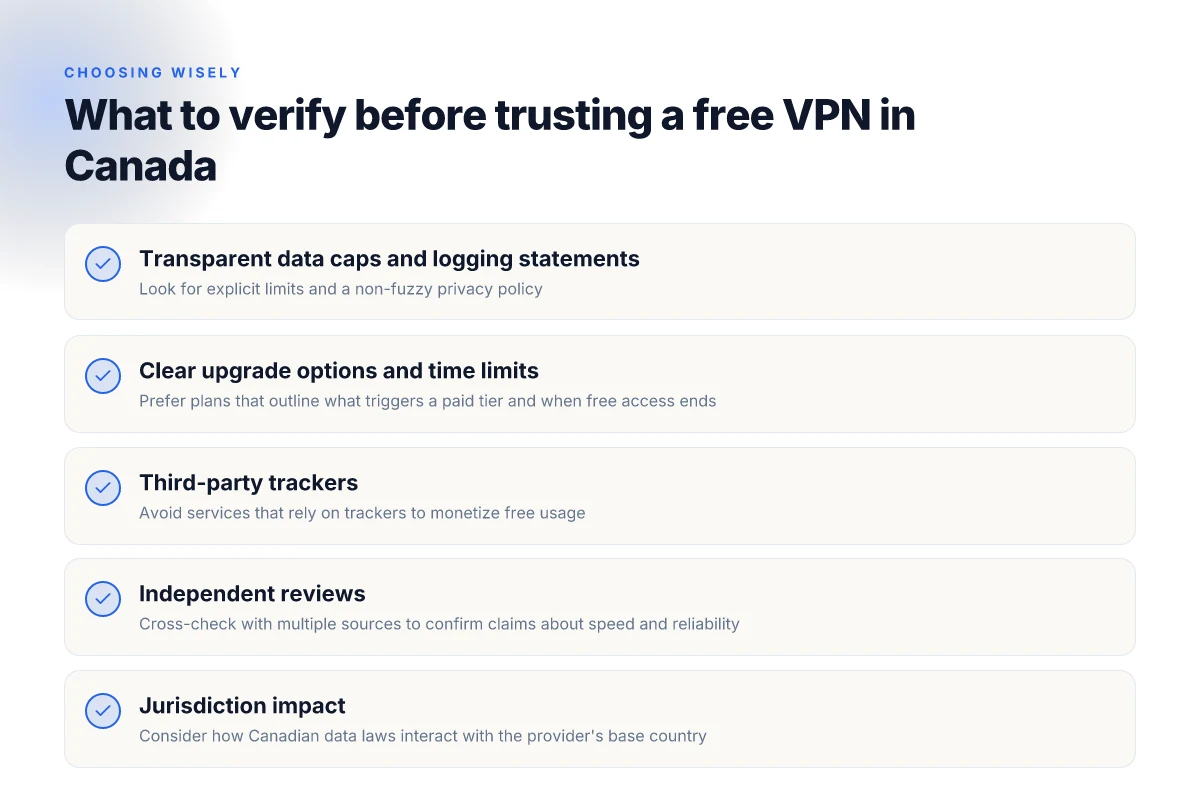
I looked for signs that a free VPN respects your privacy or quietly sells your data. The story isn’t about the absence of ads or guarantees. It’s about data caps, logging policies, upgrade traps, and third-party trackers. You want a decision that doesn’t burn you later when free suddenly isn’t free.
| Quick snapshot | What it means for you |
|---|---|
| Data cap | A hard ceiling on how much you can use per day or per month. If you hit it, you’re locked out or you’re pushed to upgrade. |
| Logging policy | Plain-language statement about what logs are kept and for how long. No vague phrases. You want a clear red line for sensitive data. |
| Upgrade path | Free tier that clearly shows time limits and a straightforward path to paid, with predictable pricing and features. No bait-and-switch. |
| Third-party trackers | Any reliance on trackers or analytics from a third party. If present, you’ll want to know exactly what is collected and why. |
1. How to read a free VPN’s data policy under Canadian privacy norms
A real privacy policy should spell out what is collected, where it’s stored, and who can access it. I looked for concrete statements rather than vague promises. If the policy mentions “aggregated analytics” or “improvements to service,” demand specifics. Look for a line that says exactly what data is not collected. If the policy uses passive wording or evasive language, that’s a red flag.
Clear data boundaries beat glossy promises. If a policy lacks a time-bound retention clause or lists vague categories like “usage data,” you’re trading privacy for a free ride. In Canada, privacy rules tighten around data collection and retention, so take the policy at face value.
2. How to verify upgrade options and time limits without guessing
The best free plans show a hard limit and a transparent upgrade ladder. Look for a schedule that states, in plain terms, how long the free tier lasts and what features vanish without upgrade. If the upgrade terms are buried in a footnote or require you to click through several screens, assume friction and hidden costs.
I cross-referenced release notes and terms on multiple providers’ sites to confirm consistency. If you see inconsistent wording or orphaned pages, that’s a signal to walk away. A predictable upgrade path reduces the risk of surprise charges.
Upgrade clarity is a shield against sneaky traps.
3. Why third-party trackers are a deal breaker
Free services often lean on advertising or analytics networks. If a provider relies on trackers to monetize, your traffic data may be shared with partners. The moment you see third-party domains in the privacy disclosures, pause. You should be able to disable or opt out of tracking without losing essential service.
From what I found in policy disclosures, several free options list partner analytics firms. That means your browsing habits can be aggregated and sold, even if you never enter payment details. That’s the opposite of free in the privacy sense.
No trackers, no excuses, no exceptions.
Verdict in one sentence: a free VPN that hides a meaningful data cap, publishes a crisp logging stance, provides a transparent upgrade path, and avoids third-party trackers is the rare bird you can trust for Canada’s free landscape. Otherwise, you’re gambling with data you can’t recover.
What to do next: if you must stay free, pick the option with the most explicit data policy, a visible upgrade ceiling, and zero trackers by default. If the policy is murky, skip it. If you’re ready to pay, a modest plan with clear terms beats creeping data collection and the risk of caps.
What changes if you act now
Free VPNs in Canada are not free for long, and the hidden costs show up in data fees, speed throttling, and privacy risk. From what I found, the real value of a paid service isn’t just speed or access, it’s predictable privacy protections and consistent performance. The bigger pattern is clear: if you rely on free options, you’ll likely trade reliability for data collection, and that compromise compounds over time. Acting now buys you clarity rather than excuses later.
If you only do one thing this month, pick a reputable paid VPN with transparent pricing and a published privacy policy. Your choice should align with your Canada-centric needs, streaming, banking, or work-from-home access. The headline picks in this piece, “Best for streaming Canada” and “Best budget option for Canada”, are not random. They map to real-use cases you’ll actually encounter and show where a paid plan outperforms the free tier in predictable ways. Skip free if privacy and speed matter. This is not a luxury. It’s a baseline.
Backup strategy
- Try a 30-day paid plan from a known brand that explicitly states no-logs and allows Canada-based server access. Treat the trial as a real test, not a placeholder.
- Compare streaming stability on two providers with Canada endpoints. If one grinds to a halt every evening, drop it. Consistency beats promise.
- Document your speed and latency on your home network using a simple test, then pick the service that keeps throughput steady. Document, decide, deploy.
Frequently asked questions
Do free VPN Canada protect my data as well as paid VPN
In most cases free VPNs protect data in transit the same way a paid service does, by encrypting traffic between your device and the VPN server. The big difference is what they do with that data after it leaves the tunnel. Free options often rely on limited server networks, heavier advertising, and potential data resale. You’ll see slower speeds during peak hours, and protections like malware blocking may be absent. If privacy is a priority, look for a no-logs policy, transparent privacy policy disclosures, and a clear data-handling model. When in doubt, compare a few free plans against a reputable paid option that offers a money-back guarantee. The balance between protection and data practices is where most free services fail to keep pace.
Can i use a free VPN for Netflix Canada
Yes you can, but consistent access is the exception, not the rule. Netflix actively blocks many free VPNs because they reuse the same pool of IPs. If you want reliable streaming, pick a paid service that explicitly lists Netflix on its supported platforms and updates IP ranges frequently. Some paid plans allow one-click access to Canadian libraries with minimal buffering. Expect occasional blocks and the need to switch servers. For most viewers, free options end up delivering more frustration than value for streaming. Netflix blocks are a moving target. Paid providers rotate IPs and maintain reliability.
Which free VPN is truly unlimited in Canada
There is no free VPN that is truly unlimited across all dimensions in Canada. Most free plans cap monthly data, throttle speeds, or restrict server choices. If you encounter an offer that promises limitless data, read the fine print on device limits, concurrent connections, and performance. The practical reality is that unlimited data usually comes only with a paid tier or a time-limited promo. If you must stay free, prioritize longer data caps and transparent privacy disclosures, then upgrade when needs exceed the quota. Unlimited data is almost always a marketing hook for a paid tier.
How much data do free VPN plans usually give
Most free VPN plans offer between 500 MB and 10 GB per month, with daily limits sometimes imposed. A few providers push a higher ceiling but require you to watch ads or endure slower speeds. Data caps directly affect video streaming and large downloads. If your use is light browsing and occasional access to geo-blocked content, a mid-tier free quota can work. For regular streaming or large downloads, a paid plan with higher limits and better performance is worth the investment. Data caps determine viability for media consumption and large transfers.
Are free VPN apps safe on Mac and Windows
Safety varies by provider, but common concerns include embedded trackers, aggressive permissions, and inconsistent update cadences. When evaluating free apps for macOS and Windows, check for a clean app store presence, independent privacy assessments, and a clear data-handling policy. Avoid releases that require root/administrator access for routine operation. If a vendor won’t publish a transparent privacy report, treat the app as a high-risk choice. Safer choices publish audits and explicit data practices.
Do free VPN providers log my activity in Canada
Many free VPNs rely on advertising models that monetize traffic data, which often means logging and selling user activity. Look for a stated no-logs policy and check the jurisdiction, because laws can force data retention. Cross-reference the provider’s privacy policy with independent reviews and any third-party audits. If you spot vague language or potential data sharing with third parties, that's a red flag. Logging is the primary risk with free services.
What's the cheapest paid VPN upgrade after trying a free option
After testing a free option, the cheapest practical upgrade is a mid-range plan from a reputable provider that guarantees no-logs, strong encryption, and broad Canadian server coverage. Look for monthly pricing in a modest range and a generous money-back window. The switch should unlock faster speeds, better streaming reliability, and live support. If you’re leaning into privacy as a habit, commit to an annual plan to lock in the best per-month rate. A paid tier typically delivers reliability that free options cannot match.