Is NordVPN legal in Canada
A clear guide to whether using NordVPN is legal in Canada and what you should know about privacy, law, and access.
Canada generally allows the use of VPNs, including NordVPN. However, the legality of using a VPN is distinct from the legal obligations that come with data retention, government access, and enforcement. This article explains the current legal landscape, how it affects NordVPN users in Canada, and practical considerations for privacy-minded users.
The legal status of VPNs in Canada
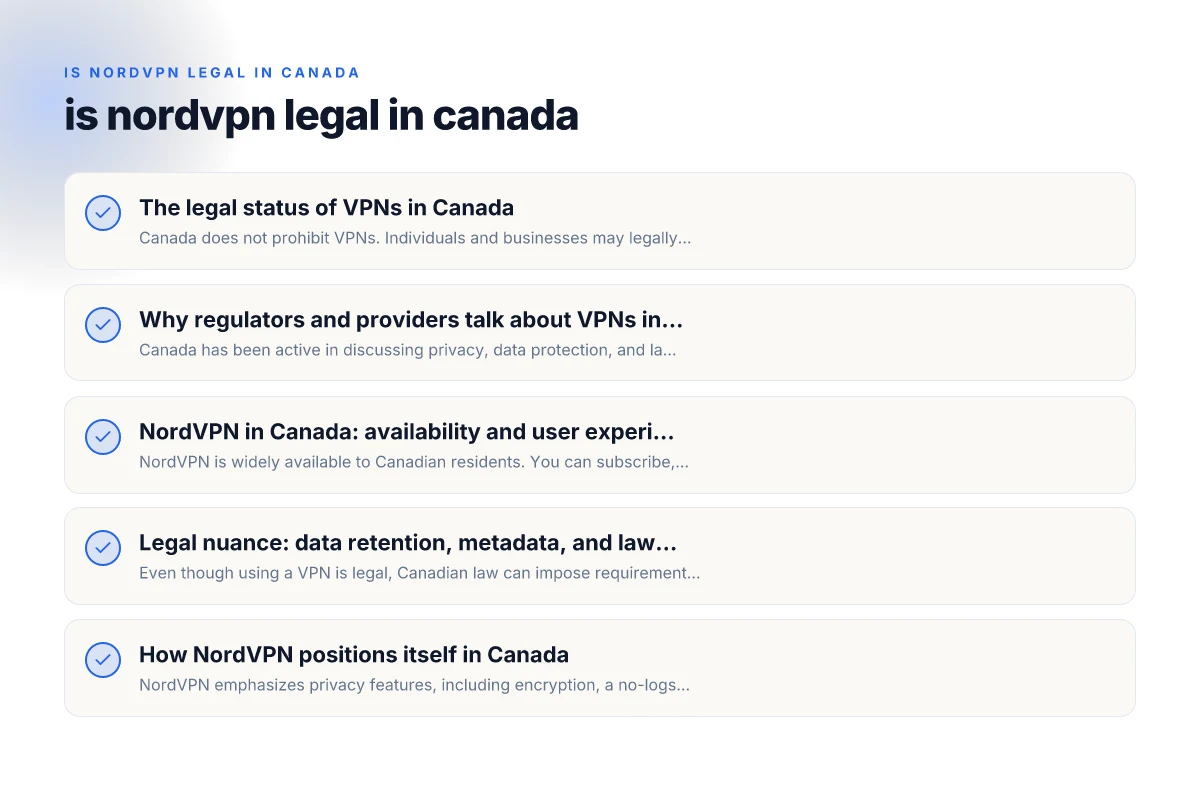
Canada does not prohibit VPNs. Individuals and businesses may legally operate and use virtual private networks to protect online privacy, secure communications, or for legitimate activities like remote work. VPN services themselves are legitimate businesses that comply with Canadian laws when operating within the country.
- What that means in practice:
- You can subscribe to NordVPN in Canada and use it on your personal devices.
- There is no blanket ban on consumer VPNs, and reputable providers operate within Canadian regulatory frameworks.
- Some countries impose restrictions or outright bans on VPNs. This article focuses on Canada, where the legal position is permissive.
Why regulators and providers talk about VPNs in Canada
Canada has been active in discussing privacy, data protection, and lawful access to information. Bills and policy debates have centered on how metadata, encryption, and cross-border data flows should be handled for national security and law enforcement purposes. These discussions influence the broader ecosystem. They do not make VPN usage illegal.
- Key themes researchers and policymakers focus on:
- How service providers handle user metadata and logs.
- The obligations of tech and communications firms to assist in investigations (lawful access).
- The balance between user privacy, encryption, and national security concerns.
NordVPN in Canada: availability and user experience
NordVPN is widely available to Canadian residents. You can subscribe, install the app on devices, and use it for typical purposes such as private browsing, securing public Wi-Fi, or accessing region-restricted content where permitted by both the service and local laws.
- Practical considerations for Canadians:
- NordVPN’s commitment to a no-logs policy (as claimed by the provider) is central to privacy-minded users. Always review current policy details and privacy reports.
- If a regulator or court requires data, the provider’s ability to comply depends on its logging practices and data storage infrastructure.
- In some high-profile regulatory discussions, providers have warned they might alter or suspend operations in Canada if metadata surveillance laws pass. This is a scenario to monitor but does not currently ban VPN usage.
Legal nuance: data retention, metadata, and lawful access
Even though using a VPN is legal, Canadian law can impose requirements on service providers about data retention and assistance to law enforcement. This matters for VPNs in two ways:
Lawful access and metadata: ProtonVPN Canada servers
Some laws may require service providers to maintain certain logs or to assist with investigations (under lawful access regimes).
A VPN that claims a strict no-logs policy aims to minimize this data footprint, but users should understand what “no-logs” means in practice (what data is collected, for how long, and under which circumstances it could be compelled).
Jurisdiction and data storage:
If a VPN provider’s servers are located outside Canada, data may be subject to foreign laws and data requests.
NordVPN operates data centers worldwide. Users should review where the service stores information and how it responds to government data requests. Surfshark Canada price: what Canadians pay for VPN access in 2026
What to watch for:
- Government bills or regulatory changes aimed at enhanced surveillance or metadata collection can influence the operating environment for VPNs.
- Providers may publicly warn about potential changes that could affect their willingness or ability to operate in a given jurisdiction.
How NordVPN positions itself in Canada
NordVPN emphasizes privacy features, including encryption, a no-logs policy, and security-focused protections. In Canada, this positioning has to navigate evolving legal expectations about data requests, metadata, and cooperation with authorities.
- What this means for users:
- If privacy is your primary goal, prioritize features like DNS leak protection, kill switch, multi-hop connections, and audited no-logs claims.
- Be aware that regulatory developments may alter how providers handle data requests in the future.
- Stay informed about any public statements from NordVPN regarding potential changes in Canada, such as responses to new surveillance laws.
A practical guide: using NordVPN legally and safely in Canada
To maximize legal compliance and privacy protection while using NordVPN in Canada, consider the following steps:
- Read and understand the privacy policy:
- Look for explicit statements about logs, data collected, and data retention periods.
- Check whether the policy has become more restrictive or more permissive over time.
- Review the terms of service:
- Understand usage rights, device limits, and any service restrictions that might be relevant to your country.
- Enable privacy-protective features:
- Use a strong VPN protocol, enable the kill switch, and turn on DNS leak protection.
- Consider features such as double VPN or obfuscated servers if you have heightened privacy requirements.
- Stay informed about regulatory developments:
- Lawful access bills and metadata-related regulations can change the privacy landscape.
- Follow reputable tech and privacy outlets for updates on Canadian policy, Bill C-XX (as applicable) or other proposed measures.
- Be mindful of content and service terms:
- Some streaming services and websites actively block VPN traffic. This is not a legal issue. It can affect your user experience.
- In regulated contexts (like corporate or academic networks), respect their policies on VPN use and network traffic.
Quick comparison: VPNs in Canada vs. other jurisdictions
A short comparison can help illustrate how Canada fits into the global VPN landscape. The table below highlights typical considerations across different regions.
| Region / Jurisdiction | Legality of VPN use | Data retention requirements | Government access regime | Typical user experience concerns |
|---|---|---|---|---|
| Canada | Legal and common | Varies by law; some regimes encourage or require data retention for providers | Lawful access with court orders; providers may be compelled to assist | Strong privacy protections, ongoing policy debates; reliability of service is high due to mature market |
| United States | Legal; widespread use | Encrypted communications may carry retention implications for certain services | National security and law enforcement can compel data; business records subject to warrants | Mixed streaming access; some services counter VPN usage |
| Western Europe (general) | Legal; many countries support private browsing | Varies by country; GDPR-era transparency often improves accountability | Data access governed by court orders and privacy regimes | Strong privacy culture; many providers audited for compliance |
| Countries with bans | Not legal; usage can be restricted | Often unrelated due to prohibition | Authorities may block or disrupt VPN services | High risk; limited access to reputable providers within the country |
Note: The table reflects typical patterns. Always verify the current legal specifics in your jurisdiction and with the VPN provider. ExpressVPN Canada price
| VPN | From / month | Plan | Free plan | Refund | Alipay | UnionPay | Crypto | Website opens in China | Trustpilot | |
|---|---|---|---|---|---|---|---|---|---|---|
 NordVPN | $3.49/mo | 27 months: $94.23 | No | 30 days | ? | ✗ | ✓ | ✓ | ✗ Blocked | 4.2/5 (51,628 reviews) |
 StrongVPN | See site | See site | No | 30 days | ✓ | ✗ | ✗ | ✗ | ✗ Blocked | 4.4/5 (2,695 reviews) |
 ZoogVPN | $2.49/mo | 27 months: $59.99 | Yes | 7 days | ✓ | ✓ | ✓ | ✓ | ✓ Yes (2.5 s) | 4.2/5 (195 reviews) |
 ExpressVPN | $3.00/mo | 28 months: $84 | No | 30 days | ✗ | ✗ | ✓ | ✗ | ✗ Blocked | 4.4/5 (29,706 reviews) |
 Surfshark | See site | See site | No | 30 days | ✗ | ✗ | ✗ | ✓ | ✗ Blocked | 4.3/5 (31,823 reviews) |
 Proton VPN | $2.99/mo | 12 months: $35.88 | Yes | 30 days | ✗ | ✗ | ✗ | ✓ | ✓ Yes (2.5 s) | 2.1/5 (1,040 reviews) |
 Astrill VPN | $12.50/mo | 24 months: $300 | No | See site | ✗ | ✗ | ✗ | ✓ | ✗ Blocked | 1.3/5 (110 reviews) |
 Private Internet Access | $2.03/mo | 40 months: $81.2 | No | 30 days | ✗ | ✗ | ✗ | ✗ | ✗ Blocked | 4.2/5 (11,033 reviews) |
 CyberGhost | $2.19/mo | 28 months: $61.32 | No | 45 days | ✗ | ✗ | ✗ | ✓ | ✗ Blocked | 4.0/5 (24,178 reviews) |
 PureVPN | $1.69/mo | 60 months: $101.55 | No | 31 days | ? | ✗ | ✗ | ✓ | ✓ Yes (2.6 s) | 4.4/5 (17,994 reviews) |
 AdGuard VPN | $2.99/mo | 24 months: $71.76 | Yes | 30 days | ✓ | ✗ | ✓ | ✓ | Official site blocked; our special link opens (2.3 s) | 4.3/5 (290 reviews) |
 Mullvad | $5.61/mo | €5/mo | No | 14 days | ✗ | ✗ | ✗ | ✓ | ✗ Blocked | 3.2/5 (192 reviews) |
 Windscribe | $5.75/mo | 12 months: $69 | Yes | See site | ✗ | ✗ | ✗ | ✓ | ✗ Blocked | 4.7/5 (13,355 reviews) |
 LightXtreme 闪连 | $7.08/mo | 12 months: $84.99 | Yes | 30 days | ✓ | ✓ | ✓ | ✓ | ✓ Yes (2.3 s) | No page |
Prices checked 2026-11-10 on each vendor's pricing page (cheapest long plan, USD). Check the vendor's checkout for the final price.
Payment methods checked 2026-11-10 on each vendor's payment pages: all 14 take cards and PayPal; ✗ = not listed, ? = the vendor's own pages disagree.
China access: whether the official website opens from mainland China networks (tests the website only, not the VPN connection). Last checked 2026-11-11 04:07 Beijing time.
Trustpilot score and review count checked 2026-11-10.
Common questions people ask (FAQ)
Q: Can I use NordVPN in Canada legally? A: Yes. Using NordVPN in Canada is legal. You can subscribe, download, and use the service like most other Canadians.
Q: Will NordVPN keep logs that could be handed to authorities in Canada? A: NordVPN publicly advertises a no-logs policy. However, legal requirements can evolve, and providers may be compelled to cooperate with lawful orders. Review the latest privacy policy and any independent security audits for current details.
Q: Is NordVPN blocked or restricted in Canada? A: NordVPN is not blocked in Canada. Some online services or streaming platforms may try to block VPN traffic, but that is not a jurisdiction-wide ban.
Q: Can NordVPN protect me from government surveillance in Canada? A: A VPN can protect your online activity from local network eavesdropping and certain types of tracking on public networks, but it does not make you immune to lawful investigations or metadata requests. Privacy tools should be used as part of a broader privacy strategy.
Q: Should I be worried about upcoming privacy bills in Canada? A: It’s wise to stay informed about regulatory developments. Bills that increase data retention or broaden government access can affect how VPNs operate. Consider following credible tech news and privacy organizations for updates. NordVPN Canada price
Final recommendation
If your primary goal is privacy and security while using the internet in Canada, NordVPN remains a reputable option within a lawful framework. The key is to understand that a VPN, including NordVPN, is not a guaranteed shield against government data requests or legal obligations. You should:
- Verify the latest no-logs posture and independent audits for NordVPN.
- Enable robust privacy features (kill switch, DNS leak protection, strong encryption).
- Stay aware of regulatory developments related to lawful access and data retention in Canada.
- Use additional privacy practices, such as secure messaging apps, updated devices, and careful handling of personal information.
Bottom line: is nordvpn legal in canada? Yes. Is it a perfect privacy solution in every scenario? No. It is a tool in a broader privacy toolkit, and users should stay informed about the evolving legal landscape to ensure their use remains compliant and aligned with their privacy goals.