How to use a VPN in Canada
A practical guide to choosing, setting up, and using a VPN in Canada for privacy, streaming, and secure browsing.
Using a VPN in Canada is straightforward, but the best results come from understanding what a VPN does, how to pick one, and how to set it up properly. This guide walks you through the essentials, from legality and safety to setup steps and everyday use, so you can stay private online, access geo‑restricted content responsibly, and keep your data secure on Canadian networks.
What a VPN does in Canada
A virtual private network (VPN) creates a secure, encrypted tunnel between your device and a VPN server. From there, your traffic exits to the internet with the VPN server’s IP address. In Canada, that means:
- Your online activity is obfuscated from local wi‑fi providers, network operators, and potential eavesdroppers on public networks.
- You can appear to browse from a different location, useful for privacy and geolocation testing.
- Some services and streaming platforms may detect and block VPNs or restrict content. Reputable providers work to minimize this.
Important notes:
- A VPN is not a magic shield against all online tracking. Websites can still collect data through other means (fingerprinting, account login, etc.).
- In Canada, using a VPN is legal for most purposes, but do not use it for illegal activities. Always comply with local laws and terms of service.
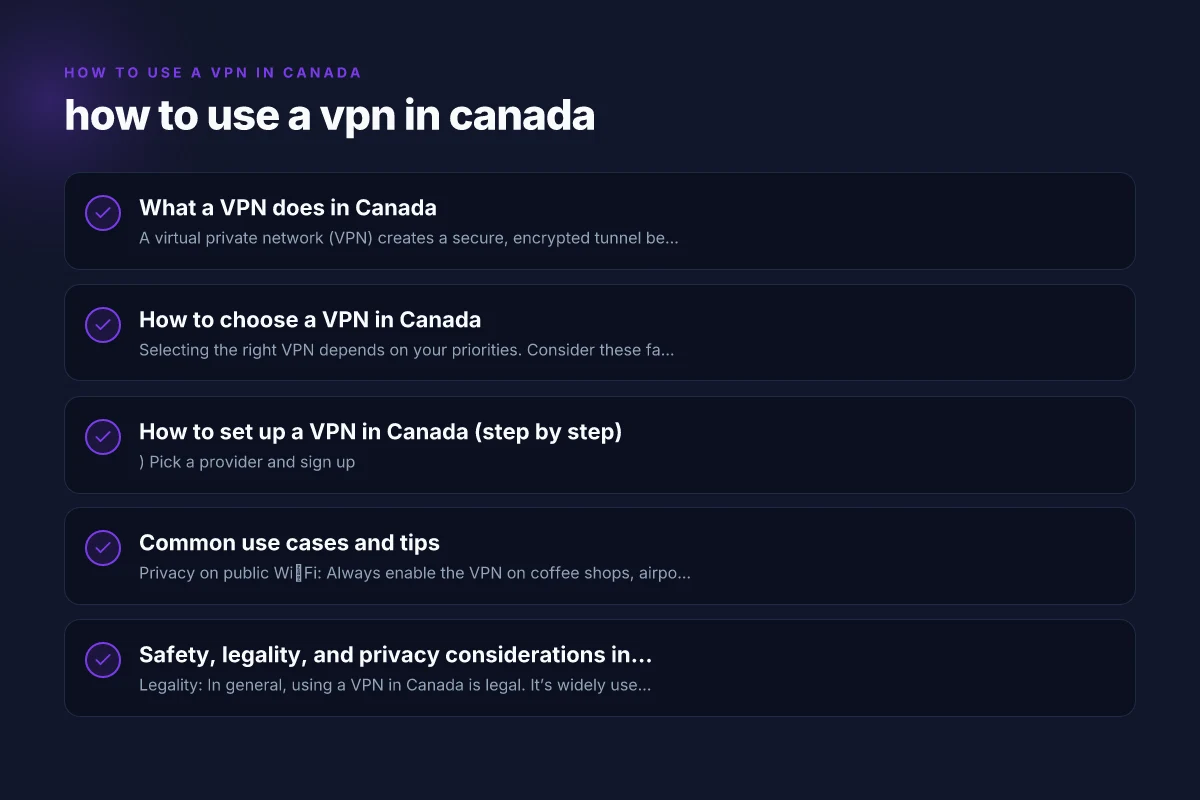
How to choose a VPN in Canada
Selecting the right VPN depends on your priorities. Consider these factors:
- Privacy and security: Look for a strict no‑logs policy, strong encryption (AES‑256), secure protocols (WireGuard, OpenVPN), and a transparent privacy policy.
- Canadian servers: If your goal is to access Canadian content or test local services, ensure the provider has reliable Canadian locations.
- Speed and reliability: Streamers and gamers benefit from fast servers and low latency.
- Compatibility: Apps for Windows, macOS, iOS, Android, and browser extensions can save you time.
- Jurisdiction and policy: Most people prefer providers based in privacy‑friendly jurisdictions with independent audits.
- Price and value: Balance cost with features such as multi‑device support and simultaneous connections.
- Customer support: Read reviews about live chat, email response times, and knowledge bases.
Here’s a quick comparison of common features to consider:
| Feature | What it means for you | How to evaluate |
|---|---|---|
| No‑logs policy | Your activity isn’t stored by the VPN provider | Check the privacy policy and audits |
| Jurisdiction | Where the company is legally based | Look for privacy‑friendly regions |
| Encryption (AES‑256) | Strength of data protection | Ensure it’s standard for security |
| Protocols | How traffic is tunneled | Prefer WireGuard/OpenVPN for balance of speed and security |
| Kill switch | Blocks internet if VPN drops | Essential for real‑time privacy |
| Split tunneling | Choose which apps use VPN | Handy for local access vs. privacy |
| Simultaneous devices | How many devices can connect at once | Pick a plan that fits your household |
| Canada server availability | Ensures fast, local exit points | Check server count and latency data |
| Speeds | Real‑world performance | Look for uptime and speed tests |
How to set up a VPN in Canada (step by step)
- Pick a provider and sign up
- Choose a reputable VPN with positive independent reviews.
- Create an account and select a plan with enough simultaneous connections.
- Download and install
- Get the official app from the provider’s website or app store.
- Install on your primary devices: Windows/macOS, iOS/Android, and browser extensions if offered.
- Sign in and configure
- Log in with your new account.
- Enable important protections: the kill switch, leak protection (DNS/IP), and the protocol you prefer (WireGuard is a good default).
- Connect to a server
- Open the server list and select a Canadian server if your goal is Canadian content or local privacy protection.
- If you’re abroad and want a Canadian exit, connect to a Canadian server.
- Test your connection
- Verify your IP address shows a Canadian location if that’s your goal, or confirm you’re using the VPN by checking a site like whatismyip.
- Check for DNS and WebRTC leaks to ensure your real location isn’t leaking.
- Optimize for streaming or gaming (optional)
- For streaming, choose a server optimized for media or one that the service lists as compatible.
- For gaming, pick a nearby server with low latency and test ping.
Common use cases and tips
- Privacy on public Wi‑Fi: Always enable the VPN on coffee shops, airports, or libraries to protect your data.
- Streaming across borders: Some Canadian users want Canadian IPs or access to US libraries. Use servers in the required country, but be mindful of terms of service.
- Work‑from‑home security: If your employer provides a VPN, you’re likely already using a corporate VPN. A personal VPN can add a second layer of privacy on non‑work traffic, but keep corporate VPN usage first for access to resources.
Tips for reliable performance: VPN for canadian travellers
- Prefer modern protocols like WireGuard for speed, but OpenVPN remains very secure and compatible with many networks.
- Use a local (nearby) server for gaming or general browsing to reduce latency.
- Turn on the kill switch to prevent accidental data leaks if the VPN disconnects.
- Keep your apps updated to avoid compatibility issues with new VPN features.
Safety, legality, and privacy considerations in Canada
- Legality: In general, using a VPN in Canada is legal. It’s widely used for privacy, security, and access to services.
- Policy adherence: You should not commit crimes or violate terms of service while using a VPN. The VPN provider’s logs and law‑enforcement requests may still apply in certain scenarios.
- Data protection: Canada has strong privacy laws, but a VPN adds another layer between you and your internet traffic. Understand the provider’s retention policies and whether they share data with third parties.
- Leaks and IP exposure: DNS leaks or WebRTC leaks can reveal your real IP even when connected to a VPN. Use built‑in protections and periodically test for leaks.
How to use a VPN for different devices (quick guide)
- Windows/macOS: Install the app, pick a server, enable kill switch, test IP.
- iPhone/iPad: Install from App Store, choose a Canadian or required server, enable VPN connection in settings.
- Android: Install from Google Play, configure per app or devicewide, test connection.
- Routers: Some users set up VPN on a compatible router for all devices at home. This can cover smart TVs, consoles, and IoT devices but may require more initial setup.
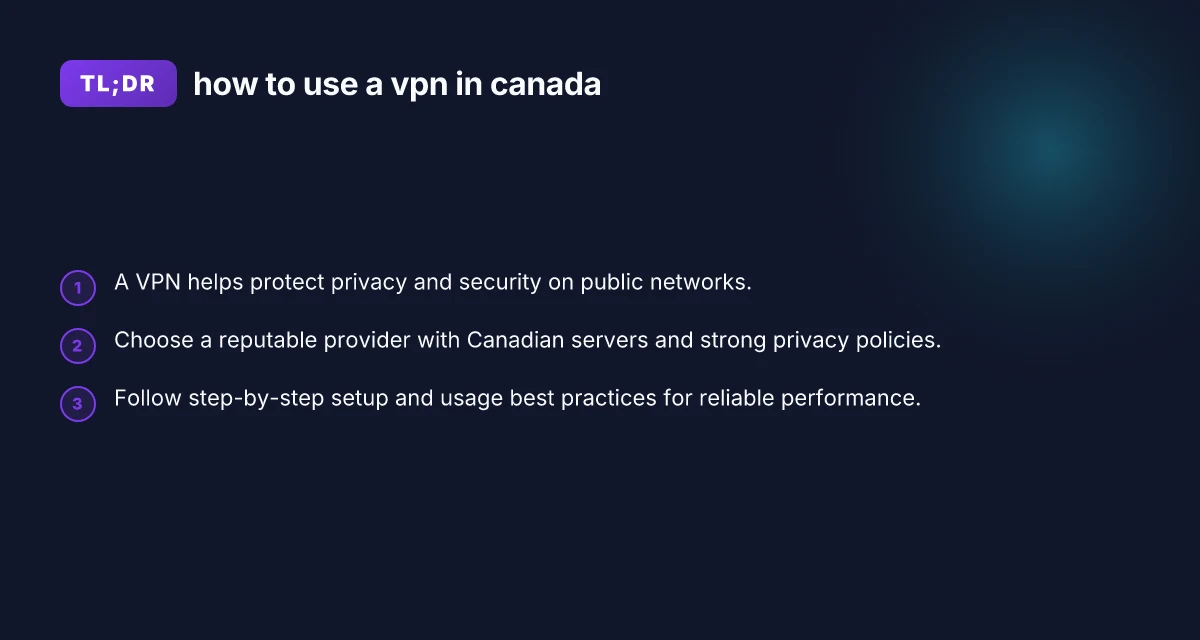
Troubleshooting common issues
- Connection fails to start: Check subscription status, try a different server, or switch protocols (e.g., from WireGuard to OpenVPN).
- Slow speeds: Move to a closer server, check for local network problems, or test during off‑peak hours.
- IP leaks: Run a leak test, enable DNS leak protection, and ensure the kill switch is active.
- Access blocks: Some streaming services detect VPNs. Try a different server or use a provider known for better unblocking capabilities.
Practical tips for staying private and secure
- Use multi‑factor authentication on your VPN account and email.
- Keep your operating system and apps updated to mitigate vulnerabilities.
- Avoid using public networks for sensitive tasks without a VPN, and consider device encryption where possible.
- If you’re using a family plan, manage devices and permissions to avoid accidental exposure.
Quick comparison: streaming vs. privacy focus
If you’re primarily after streaming in Canada, you may prioritize: server variety, high speed, and unblocking capabilities. If your main goal is privacy and security, you’ll want strong encryption, a strict no‑logs policy, and robust leak protection.
| Goal | What to prioritize | Example checks |
|---|---|---|
| Streaming and unblocking | Lots of Canadian and international servers; good unblocking reputation; fast speeds | Verified streaming support, server lists, latency data |
| Privacy and security | No‑logs policy; strong encryption; kill switch; leak protection | Privacy policy audits, independent reviews, security features |
| Gaming | Low latency; stable connections; proximity to you | Ping tests, quick reconnects, optimized gaming servers |
Final recommendation
For most Canadians who want a straightforward, reliable experience, choose a well‑regarded VPN with strong privacy practices, multiple Canadian servers, fast performance, and robust security features. Set up the app on your primary devices, enable the kill switch and leak protection, and connect to a nearby Canadian server for everyday use. If your goal is streaming from other regions, pick a provider that explicitly lists unblocking capabilities and regularly tests its compatibility with your favorite services.
If you’d like, tell me your main use case (privacy, streaming, gaming, or work security) and your device lineup. I can suggest a tailored setup and specific server recommendations, plus steps to test and verify your connection for optimal privacy and performance.
| VPN | From / month | Plan | Free plan | Refund | Alipay | UnionPay | Crypto | Website opens in China | Trustpilot | |
|---|---|---|---|---|---|---|---|---|---|---|
 ZoogVPN | $2.49/mo | 27 months: $59.99 | Yes | 7 days | ✓ | ✓ | ✓ | ✓ | ✓ Yes (2.5 s) | 4.2/5 (195 reviews) |
 NordVPN | $3.49/mo | 27 months: $94.23 | No | 30 days | ? | ✗ | ✓ | ✓ | ✗ Blocked | 4.2/5 (51,628 reviews) |
 ExpressVPN | $3.00/mo | 28 months: $84 | No | 30 days | ✗ | ✗ | ✓ | ✗ | ✗ Blocked | 4.4/5 (29,706 reviews) |
 Surfshark | See site | See site | No | 30 days | ✗ | ✗ | ✗ | ✓ | ✗ Blocked | 4.3/5 (31,823 reviews) |
 Proton VPN | $2.99/mo | 12 months: $35.88 | Yes | 30 days | ✗ | ✗ | ✗ | ✓ | ✓ Yes (2.5 s) | 2.1/5 (1,040 reviews) |
 Astrill VPN | $12.50/mo | 24 months: $300 | No | See site | ✗ | ✗ | ✗ | ✓ | ✗ Blocked | 1.3/5 (110 reviews) |
 Private Internet Access | $2.03/mo | 40 months: $81.2 | No | 30 days | ✗ | ✗ | ✗ | ✗ | ✗ Blocked | 4.2/5 (11,033 reviews) |
 CyberGhost | $2.19/mo | 28 months: $61.32 | No | 45 days | ✗ | ✗ | ✗ | ✓ | ✗ Blocked | 4.0/5 (24,178 reviews) |
 PureVPN | $1.69/mo | 60 months: $101.55 | No | 31 days | ? | ✗ | ✗ | ✓ | ✓ Yes (2.6 s) | 4.4/5 (17,994 reviews) |
 AdGuard VPN | $2.99/mo | 24 months: $71.76 | Yes | 30 days | ✓ | ✗ | ✓ | ✓ | Official site blocked; our special link opens (2.3 s) | 4.3/5 (290 reviews) |
 Mullvad | $5.61/mo | €5/mo | No | 14 days | ✗ | ✗ | ✗ | ✓ | ✗ Blocked | 3.2/5 (192 reviews) |
 Windscribe | $5.75/mo | 12 months: $69 | Yes | See site | ✗ | ✗ | ✗ | ✓ | ✗ Blocked | 4.7/5 (13,355 reviews) |
 StrongVPN | See site | See site | No | 30 days | ✓ | ✗ | ✗ | ✗ | ✗ Blocked | 4.4/5 (2,695 reviews) |
 LightXtreme 闪连 | $7.08/mo | 12 months: $84.99 | Yes | 30 days | ✓ | ✓ | ✓ | ✓ | ✓ Yes (2.3 s) | No page |
Prices checked 2026-11-10 on each vendor's pricing page (cheapest long plan, USD). Check the vendor's checkout for the final price.
Payment methods checked 2026-11-10 on each vendor's payment pages: all 14 take cards and PayPal; ✗ = not listed, ? = the vendor's own pages disagree.
China access: whether the official website opens from mainland China networks (tests the website only, not the VPN connection). Last checked 2026-11-11 04:07 Beijing time.
Trustpilot score and review count checked 2026-11-10.